Bringing clarity to complex research in neuroarchitecture

hannah
For Reyhaneh Raisi, a PhD student in architecture, research is not just about collecting information—it’s about making sense of complexity. Working in neuroarchitecture, she constantly navigates ideas across disciplines, where connections are not always obvious. Over time, finding clarity became just as important as finding answers.
Facing complexity in academic research
As her PhD research progressed, Reyhaneh found herself dealing with an increasing number of notes, papers, and references. Each piece of information was valuable on its own, but putting everything together into a coherent structure was another challenge entirely.
She often moved between documents, trying to connect ideas that didn’t naturally align. New insights would emerge, but instead of simplifying her thinking, they sometimes made it feel even more layered and difficult to manage.
There were moments when she had everything she needed—but no clear way to see how it all fit together.
Finding a better way to organize ideas
While looking for a more effective way to structure her work, Reyhaneh came across Xmind. What drew her in was how naturally it allowed ideas to take shape visually.
She started by mapping out the materials she had already gathered for her thesis. Instead of keeping everything in separate places, she began building a single visual space where concepts, references, and relationships could exist together.
That shift was immediate. For the first time, she could step back and see her research as a whole—not just as isolated pieces of information.
As she continued using Xmind, it gradually became part of how she worked:
mapping relationships between concepts
grouping and reorganizing academic content
combining text and visual references in one place
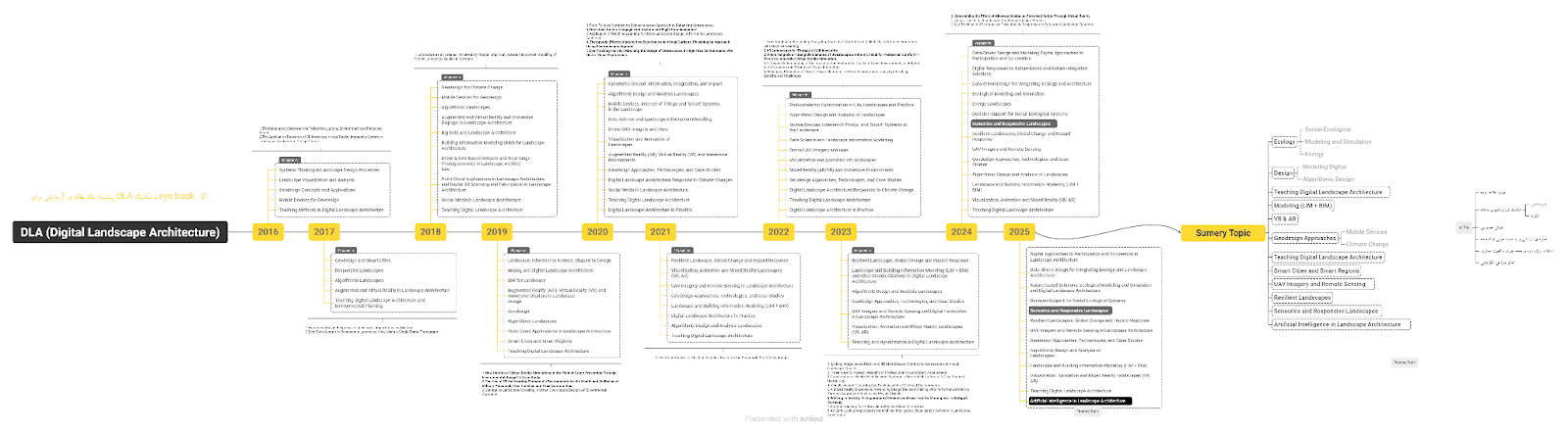
Using Xmind throughout her research process
From organizing materials to seeing connections
What began as a way to organize information soon became a way to think more clearly. As Reyhaneh revisited her maps, she started noticing patterns and connections that weren’t obvious before.
At times, she would pause on a branch and realize something was missing—or that two ideas could be linked in a new way. Instead of feeling overwhelmed, she began to feel more in control of how her research was evolving.
Presenting ideas in a more intuitive way
A turning point came when she used Xmind to prepare for a discussion with her professors. Instead of creating slides, she laid out her ideas directly in Xmind—structuring timelines and flows visually.
During the discussion, the difference was clear. Her ideas were easier to follow, and conversations became more focused, as everyone could see the structure of her thinking in real time.
That experience changed how she approached presentations moving forward.
Rethinking how research is structured and communicated
Over time, Xmind became more than a thinking tool—it influenced how Reyhaneh presented her work. She gradually moved away from traditional tables and began using visual diagrams in her papers and presentations.
Depending on what she needed to express, she would shift between different structures—using mind maps to build overviews, timelines to show progression, and fishbone diagrams to break down complex issues.
Although she hasn’t yet explored Xmind AI features, she sees strong potential in areas like generating visuals automatically and enhancing presentation capabilities, especially with Pitch Mode.
Overall, Reyhaneh recommends Xmind as an effective tool. While she hasn’t yet had the chance to fully experience its AI features, Xmind has already become an essential part of her research process. It helps her turn scattered ideas into something visible, structured, and easier to work with—bringing clarity not just to her work, but to the way she thinks about it.