From familiarity to reinvention: how a product leader rebuilt his thinking workflow with Xmind AI

hannah
Rediscovering Xmind at the right moment
For a Head of Product and Architecture, structured thinking is not optional—it is the foundation of how work gets done. Every decision, every alignment, and every explanation depends on the ability to take complexity and make it clear.
Years ago, he was introduced to Xmind by a product manager. It quickly became part of his workflow because it matched how he naturally thought—simple, structured, and flexible enough to grow ideas. But as his work evolved, so did his environment. His workflow became more cloud-based and collaborative, and the desktop version of Xmind began to feel increasingly restrictive. Without a clear decision to stop, he simply used it less over time.
That changed unexpectedly when he came across Xmind AI while reading a blog. There was no deliberate search—just a random discovery that led him to try it again. This time, it fit. The transition was immediate, and he moved away from the desktop version entirely.
Why the transition felt natural
Continuity over novelty
What made the switch work was not new features, but familiarity. For someone who had used Xmind extensively, the biggest risk in adopting a new tool was losing the way he already thinks.
Before fully committing, he was essentially validating three things:
Whether the core thinking structure remained intact
Whether interactions like shortcuts and node logic still felt natural
Whether the tool could scale without becoming messy
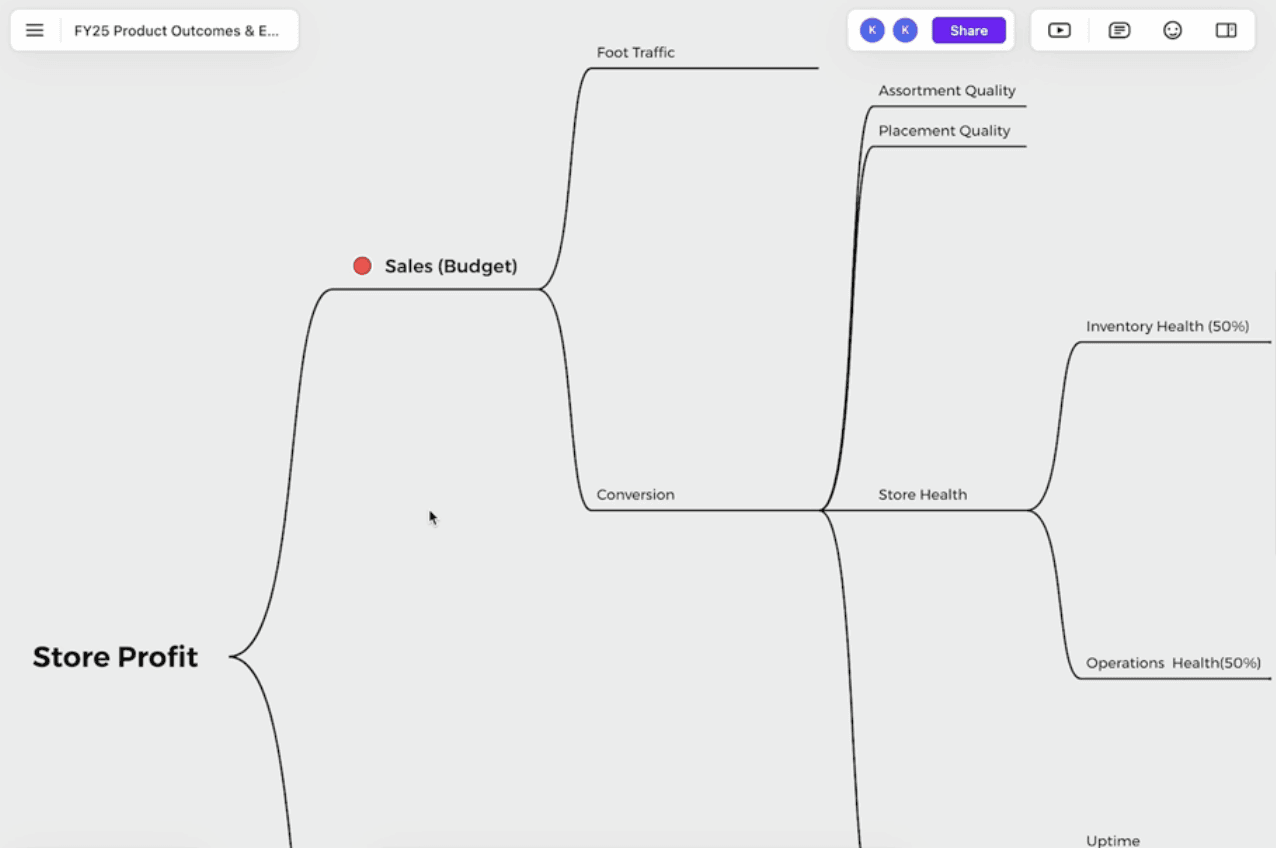
Xmind AI preserved that foundation. The shortcuts, the node structures, and the way ideas expand and connect all felt consistent. That continuity removed friction completely. Instead of adapting to a new tool, he was able to continue thinking in the same way, but in a more flexible and accessible environment.
From personal thinking to shared workflows
A tool that scales with how he works
What started as a personal thinking tool gradually became central to how he works. At an individual level, Xmind AI remained a place to organize ideas, plan approaches, and structure information—but it became faster, always available, and easier to revisit.
The real shift happened in collaboration.
Instead of keeping thinking as an internal process, it became something shared. His team began using mind maps as a working surface, building ideas together in real time rather than discussing them abstractly. This shift changed how conversations happened:
Brainstorming became more structured without losing flexibility
Discussions became more concrete and easier to follow
Alignment happened faster because everyone shared the same visual context
At the same time, it changed how he communicates with clients. Explaining complex systems often requires shifting perspectives quickly, and Xmind AI made that easier. Instead of rebuilding explanations from scratch, he could reshape the same structure into different visual narratives depending on the situation.
What used to be a static output became a dynamic communication layer.
When more ideas create new problems
As Xmind AI became more deeply embedded in his workflow, a new challenge emerged—not in creating ideas, but in managing them.
The limits of organization at scale
With increased usage came a rapid growth in mind maps. Over time, what was once a clean and intuitive space became harder to navigate.
This showed up in very practical ways:
Too many files accumulated over time
Finding the right map required more effort
Connections between ideas became less visible
The issue was not a lack of capability, but the difficulty of maintaining clarity as information scaled.
At the same time, certain parts of the experience felt slightly disconnected from how he worked. These were not major blockers, but consistent friction points:
Presentation workflows did not fully integrate into his thinking process
Topic linking helped connect ideas, but lacked a clear way to return to context
Flexible structures like floating topics existed, but lacked enough customization
Taken together, they pointed to a deeper need—not more features, but better structure.
Looking ahead: structure over features
What he is looking for next is not simply expansion, but refinement.
As the volume of ideas grows, the system around them needs to become clearer, not more complex. In practical terms, this means:
A more intuitive file and folder structure
Better navigation across maps and ideas
Smoother transitions between thinking, presenting, and exploring
The goal is not to add more layers, but to make the existing ones easier to understand and move through.
A tool that still fits how he thinks
Despite these challenges, his overall view remains clear. Xmind is still the tool that best aligns with how he thinks.
He has already introduced it to his team and continues to recommend it to others. Not just because of its features, but because it supports a way of working that scales—from individual thinking to team collaboration.
What Xmind AI ultimately changed was not his thinking process, but the friction around it.
It made ideas:
Easier to capture
Easier to share
Easier to evolve
And in doing so, it allowed structured thinking to keep up with the complexity of real work.