Stop hoarding ideas: the brain dump method for creating your first knowledge product

Hannah
Most experts don't have an ideas problem—they have a structure problem. You've spent years accumulating knowledge, experience, and observations, but the moment you sit down to write a book or design a course, everything feels overwhelming and scattered. That's exactly where brain dumping comes in.
"You have years of expertise. You have so much in your brain. But when you sit down to structure it, it feels very messy."
Dr. Subra Mukherjee knows this feeling well. As a Thinking Systems Consultant and Xmind Ambassador with over 13 years of experience, she has helped more than 11 clients write books and launch courses using a single repeatable system. In this live Xmind webinar session, she walked through her entire brain dumping process in real time—dump files, distillation logic, AI prompts, and all—using an actual book project as the demo.
Why experts stay stuck: the real problem isn't a lack of ideas
Before diving into her framework, Dr. Subra ran a live poll: What feels most difficult when turning your expertise into a course or book?
The results were telling:
Challenge | % of attendees |
|---|---|
Struggle to organize thoughts | 46% |
Don't know where to start | 28% |
Too many ideas | 17% |
It feels overwhelming | 9% |
Almost nobody said they lacked ideas. The problem, nearly universally, was structure. And the reason most people default to linear notes—Word docs, bullet lists, outlines—is actually making it worse.
"Linear tools kill thinking. The moment we start writing things in a linear way, creativity dies."
This is the case for visual thinking, and the reason Dr. Subra's entire framework is built around Xmind mind mapping. When ideas are visual and spatial, patterns emerge naturally—and those patterns become your blueprint.
The 4D Framework: a repeatable brain dump system
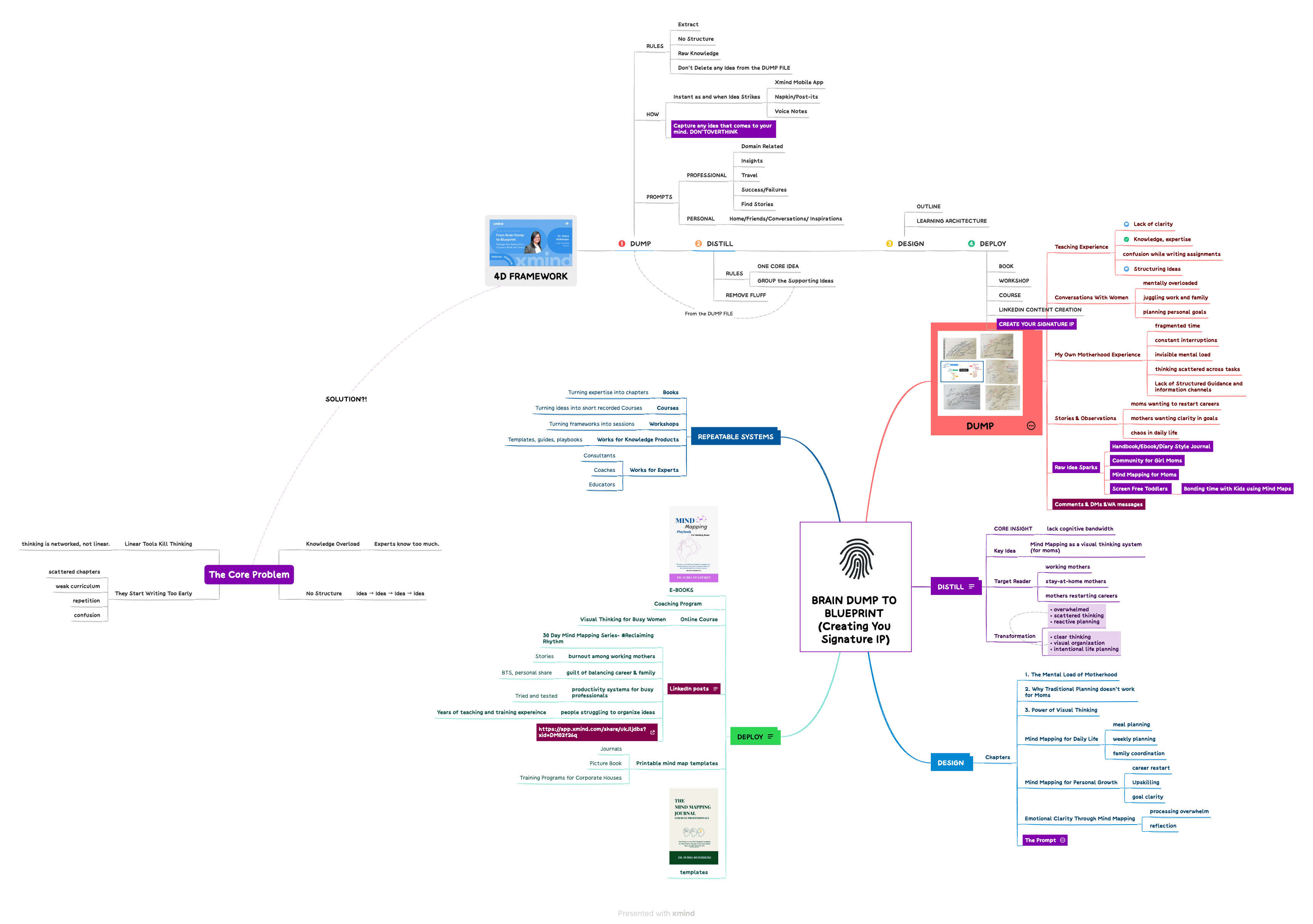
The heart of Dr. Subra's method is a four-step process she calls the 4D Framework. Here's how it maps out:
Stage | What you do | Time investment |
|---|---|---|
Dump | Capture raw ideas—no judging, no deleting | 5–10 min/day for 10–15 days |
Distill | Find patterns, extract one core insight | Weekly review session |
Design | Build the chapter/module structure | One focused session |
Deploy | Produce the final asset and repurpose it | Ongoing |
Dr. Subra's actual playbook from the session.
Dump—capture everything, judge nothing
Brain dumping at this stage means raw extraction with zero filtering. Voice notes, napkin scribbles, Xmind mobile app entries, pocket notebooks—all of it goes in. The rules are simple:
Don't delete anything
Don't judge whether an idea is good or bad
Capture as soon as the idea strikes—shower, commute, coffee with a friend
Do it daily for at least 10 minutes, or whenever your head feels full
Dr. Subra shared photos of her own dump files going back two years. Some were radial sketches. Some were barely legible. The point wasn't neatness—it was volume and honesty.
To make this concrete, she had attendees try a 1-minute live brain dump. Most generated 6–12 ideas in under 60 seconds. "Just imagine how many ideas you can generate in 5 minutes with a calm mind and a timer."
Distill—find the one thing that matters
This is where most people skip ahead, and where most projects fail. After collecting raw material for days or weeks, the work is to look for patterns.
Dr. Subra's distillation process produces four outputs—all from the same dump file:
One core insight — the repeating theme across your entries (in her case: "mental load" kept surfacing across dozens of entries about mothers, career breaks, and cognitive overwhelm)
One key idea — the specific angle or solution you'll offer
Target reader — who are you writing for? (Her dump files pointed clearly toward working mothers)
The transformation — what does the reader go from, and what do they arrive at?
Only once all four are clear does design begin. "Distillation is where thinking actually sharpens and patterns start emerging."
Design—build the architecture with Xmind AI
With a core insight, key idea, target reader, and transformation defined, designing the structure becomes far less intimidating. Dr. Subra demonstrated two approaches:
Option A: Manual design Review your distilled notes, look at the transformation arc, and sketch chapter or module names that connect the starting point to the outcome.
Option B: Xmind AI-assisted design Feed your distilled inputs as a prompt—core insight, key idea, target reader, transformation—and let Xmind AI generate a first-draft structure. Dr. Subra did this live:
Input: cognitive bandwidth, mind mapping for working mothers, overwhelm → clear thinking
Output in under 1 minute: a full book outline titled Mind Mapping for Empowered Mothers, with chapters like "The Modern Mother's Dilemma," "The Mental Load," and "The Power of Visual Thinking"
"The more specific your prompt, the more the output reflects your actual expertise—not generic results anyone could get." That specificity comes directly from doing the dump and distill phases properly.
Deploy—one blueprint, multiple assets
This is where the leverage lives. A single well-designed Xmind blueprint doesn't have to produce just one thing. Dr. Subra's playbook on working mothers has already generated—or is in the process of generating:
A 27-page ebook of mind mapping templates for busy professionals
A full-length book (Mind Mapping Playbook for Working Moms, 50 ready-to-use templates)
A completed Udemy course (created when her daughter was 3 months old—still generating revenue)
A 30-day LinkedIn content series that brought in new clients
Ideas for corporate training programs, journals, and printable templates
The key principle: your intellectual property should be repeatable and generate multiple assets. "You don't have to wait for the perfect moment."
Using Xmind AI as a thinking partner
A recurring theme throughout the session was how Xmind AI fits into this process—and equally important, where it doesn't.
Stage | Your job | Where Xmind AI helps |
|---|---|---|
Dump | 100% yours—lived experience only | ✗ Not applicable |
Distill | 100% yours—pattern recognition | ✗ Not applicable |
Design | Optional: do it yourself or use AI | ✓ Generate chapter/module structure from your prompt |
Deploy | Execution is yours | ✓ Generate LinkedIn post ideas, repurposing angles |
Dr. Subra also used Xmind AI live to generate LinkedIn post ideas from a single sentence prompt—and got structured post types, opening lines, and content angles within seconds. "You already have the source material. Xmind AI just helps you move faster."
Conclusion
The reason most experts never ship their knowledge product isn't a lack of material—it's a lack of system. Dr. Subra's 4D Framework works because it respects how thinking actually happens: messy first, structured later. Brain dumping gives you permission to capture without judging. Distillation forces you to find the signal in the noise. Design turns that signal into a blueprint. And deploy makes sure that blueprint earns its keep across multiple formats and platforms. The session ended with over 60% of attendees saying they just needed a structure—not more ideas, not more time. If that resonates, the system is already in front of you. Open Xmind, create a new map, and start dumping.
FAQ
1. What is brain dumping and how does it work?
Brain dumping is the practice of capturing every idea, thought, and observation without judging or filtering—just raw extraction. In the context of course creation or writing a book, it means collecting material daily for 1–2 weeks before trying to organize anything. The goal is volume first, structure second.
2. How long should the brain dump phase last before I start organizing?
Dr. Subra recommends a daily 5–10 minute practice for at least 10–15 days. The point is to build enough raw material that real patterns emerge when you review it—not just one brainstorm session.
3. Do I need a brain dump template to get started?
Not necessarily. Dr. Subra uses both Xmind on mobile and physical notebooks. A radial mind map works well because it mirrors how ideas actually connect—but even pen and paper with no structure is fine at the dump stage. The key is capturing, not formatting.
4. Can I use this method for course creation, not just a book?
Yes—the 4D Framework is format-agnostic. In the Design phase, replace "chapters" with "modules." The Dump, Distill, and Deploy phases work identically regardless of whether the final product is a book, online course, workshop, or LinkedIn series.
5. How specific do my Xmind AI prompts need to be?
The more specific, the better. Generic prompts produce generic output. Prompts built from your distilled core insight, key idea, target reader, and transformation produce chapter names and structures that reflect your actual expertise. That specificity can only come from doing the dump and distill phases yourself first.
Turn your expertise into a product.
Use Xmind to dump, distill, and design your ideas into a book, course, or content series—without staring at a blank page.