Building a mind palace with Xmind: A new approach to learning at scale

Hannah
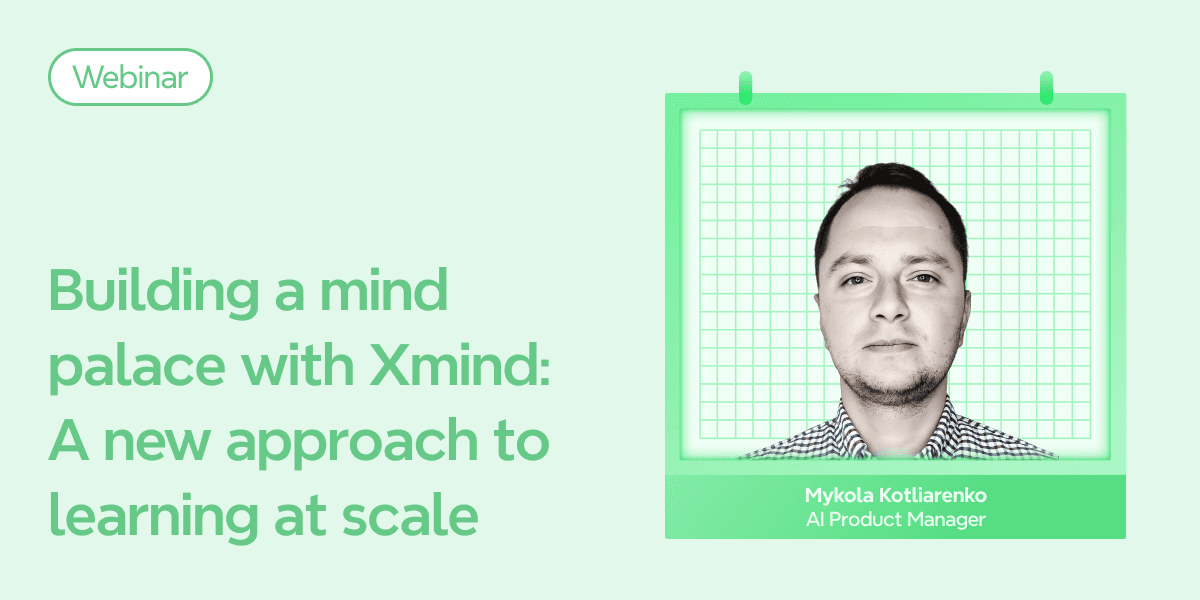
Most people use mind maps to organize a single meeting or book. Mykola Kotliarenko uses them to organize his entire mind. As an AI product manager drowning in backlogs, research papers, and unstructured data daily, he needed a personal knowledge management system that could keep up—and built one by combining an ancient memory technique, a MIT creativity framework, and Xmind.
"I'm using mind mapping so I can paint all the field like a map on a scale," he told attendees of the Xmind Ambassador Webinar. "And study specific details in the domain I'm mostly interested in."
What he shared wasn't a party trick. It was a complete framework for learning at scale—one that combines neuroscience, MIT's CRAB cycle model, and the specific features of Xmind that make it all work.
What is a mind palace—and why does it matter now?
The mind palace, known formally as the method of loci, is an ancient Greek memory technique that was largely abandoned after the printing press made external storage easy. The idea is simple: you associate information with specific locations in a familiar space, allowing your brain to navigate and retrieve it the way it navigates physical environments.
Mykola pointed out that recent research from the Alberta Institute confirms that virtual spaces work just as well as physical ones—meaning you don't need an actual building. A well-structured Xmind map functions as a digital palace with the same neurological benefits.
Why does this matter now? Because the problem has flipped. We don't struggle to store information anymore. We struggle to retrieve it, connect it, and reason across it—especially as AI tools generate more output than any individual can meaningfully absorb.
"Reasoning is actually even more important with new AI tools," Mykola said. "But most important is the ability to know the field you are studying. So you know exactly where you need to probe."
How the brain actually works—and how Xmind maps to it
Mykola's framework is grounded in how different brain regions handle different types of information:
Brain region | Function | How Mykola uses it |
|---|---|---|
Occipital lobe | Spatial navigation | Organizing information by physical location in the map |
Parietal lobe | Visual memory | Using images and screenshots embedded in nodes |
Amygdala | Emotional tagging | Emojis on every node—bugs for bugs, graduation hats for education content |
Hippocampus | Indexing and retrieval | The overall map structure that lets him navigate without opening files |
The emoji system deserves particular attention. It's not decoration—it's a deliberate technique to engage the amygdala, the part of the brain that processes emotional association and pattern-breaking. The brain remembers what's strange or unexpected. A spider web icon for "scalability" is harder to forget than the word itself.
"The more it's not like you used to think it's normal, the better," Mykola said. "So you recall it better."
Building the knowledge palace
The CRAB cycle: A structure for everything you read
Rather than organizing his knowledge management system arbitrarily, Mykola borrowed a framework from MIT: the CRAB cycle, which maps creative energy across 4 quadrants—Science, Engineering, Design, and Art.
Each quadrant represents a different type of knowledge and a different relationship to applicability:
Science — foundational, low immediate applicability (economics, mathematics, philosophy, cognitive psychology)
Engineering — applied knowledge that transforms science into tools (product management, AI, business analysis)
Design — the perception layer, shaping how products and systems feel (software design, architecture, everyday design)
Art — biographies, science fiction, culture—knowledge that reshapes how you see reality
The logic is deliberate. Pure science produces knowledge that engineering can apply. Engineering shapes design. Art and culture change your perception of all of it. Mykola reads across all 4 quadrants intentionally, the way an athlete trains different muscle groups rather than doing only push-ups.
"You can train your brain with new knowledge, new utility, new behavior, and new information produced," he said.
Memory anchors: Remembering a whole book with 4 emojis
One of the most practical demonstrations in the session was how Mykola summarizes an entire book using only a handful of visual anchors.
He used Capitalism Without Capital—a book about intangible assets—as an example. The book's 4 core concepts (synergy, sunkness, spillover, scalability) are each paired with a memorable, slightly absurd image:
🍄 Mushrooms on a tree → synergy (2 organisms producing more value together than separately)
🪞 Broken mirror → sunkness (once it's broken, you can't recover anything)
💫 Vertigo → spillover (success spreads uncontrollably to competitors)
🕸️ Spider web → scalability (expand infinitely without adding proportional cost)
With just these 4 emojis recalled, he can reconstruct the entire conceptual framework of the book. If that's not enough, his Xmind notes are one search away.
This is the method of loci applied digitally: the map is the palace, the emojis are the anchors, and Xmind's search function is the index.
Xmind in practice
Processing complex material with AI
Mykola showed how he combines AI tools with Xmind to handle large, complex material—like a 400-page technical book on AI engineering by a Stanford professor. His workflow:
Read a section of the book
Screenshot key diagrams or definitions
Ask an AI to summarize the section and generate structured nodes
Embed the summary and screenshot into the relevant branch of his Xmind map
Bold the anchors—the specific facts or formulas he needs to recall
The result is a map that functions as both a retrieval system and a comprehension aid. He can revisit a complex concept months later, see the screenshot, read the bolded anchor, and reconstruct the full understanding without re-reading the source. He also uses Xmind's cloud sync to keep everything accessible across devices. "I can work on one device, open on another device—it's always with me, including on iPhone."
Wild research: Mapping the unknown
The final use case Mykola shared was what he calls "wild research"—situations where you don't yet know what you're looking for.
When exploring a company or a new market, he starts with a single word or company name and builds outward using AI-assisted research: main products, features, strategy, ecosystem, user journeys, SWOT analysis, Porter's five forces, north star metrics. All of it lands in a single Xmind map, structured so he can navigate it visually rather than sifting through documents.
"From just one word of a company, I found main products, main features, found strategy, found ecosystem, drew main user journeys," he said. "For myself I can easily understand what that company does."
Conclusion
Mykola's system is already pushing against the edges of what Xmind can do today. In the Q&A, he shared 2 features that would take his workflow even further: Excalidraw-style drawing directly inside Xmind, and full Markdown support with an API.
That second one hints at something bigger. "If Markdown could be fully supported within Xmind and there is an API, I can use Xmind for orchestration of AI agents," he said. "I can compile code with Xmind and orchestrate my agents in a visual way."
For now, the system works—and it scales. Whether you're an AI product manager processing hundreds of research papers or a curious reader trying to get more out of the books you read, the principle is the same: stop trying to remember everything, and start building a map worth navigating with Xmind.
FAQ
1. What is a mind palace?
A mind palace—formally called the method of loci—is an ancient memory technique that associates information with specific locations in a familiar space. Research confirms that virtual spaces, like a structured Xmind map, work just as well as physical ones.
2. How is a mind palace different from regular note-taking?
Note-taking stores information externally. A mind palace trains you to retrieve and connect information from memory, using spatial, visual, and emotional cues to make recall faster and more reliable.
3. Can I build a mind palace in Xmind?
Yes. Mykola's entire system runs on Xmind—he uses the map structure for spatial navigation, emojis for emotional tagging, screenshots for visual memory, and Xmind's search function as his index.
4. What is the best tool for personal knowledge management?
There's no single answer—but the most effective knowledge management systems combine visual structure, searchability, and emotional memory cues. Mykola uses Xmind as the backbone of his system because it supports all 3: spatial map structure, full-text search, and emoji-based tagging that makes information easier to recall.
5. How long does it take to build a knowledge system like this?
Mykola started during COVID lockdown with a reading challenge. The CRAB cycle structure came later, after he read an MIT article. There was no grand plan—it grew one book, one branch at a time.
6. How does AI fit into this workflow?
AI accelerates the mapping process. Mykola uses it to summarize sections of books, generate structured nodes, and explore unfamiliar topics—then stores everything in Xmind where it becomes part of his searchable, navigable knowledge management system.
Your knowledge deserves a better home.
Use Xmind to build a visual knowledge management system that makes everything you've learned easier to retrieve, connect, and act on.