Back to the way I learn best: How mind mapping brought me back to studying
morné-olivier

My name is Morné Olivier. I am a 35-year-old Afrikaans husband and father from South Africa, and I work as a vegetable farmer. I am also taking agricultural courses because I hope to build my own businesses in the sector one day.
Learning has never come easily to me. My attention deficit disorder (ADD) makes it difficult to concentrate, while perfectionism can stop me from finishing even when I do focus. I often see the bigger picture in my head. Turning it into something I can work with is another story.
My learning challenge
Learning through mind maps
Fortunately, my mother taught me the art of mind mapping when I was in primary school. We need to thank our mothers more.
And I do not mean drawing a few circles on a page. I mean serious mind mapping. My mother used mind maps as a real way to teach, learn, and understand things. For me, that changed everything.
Studying became fun. Mind mapping held my attention, and my perfectionism suddenly became useful because I wanted every map to make sense, look right, and connect properly. I passed every school exam through the end of high school.
Losing that structure at university
But then came university.
Most of my work had to be completed on a laptop. Assignments became long essays, and the amount of study material felt too large to map in the way I had learned as a child. The way I understood information no longer matched the way I was expected to study.
I choked.
Almost every assignment was late or submitted incomplete. The ones I finished were often very good, but they came at the cost of my other subjects. A three-year degree turned into a six-year challenge.
Finding my way back with Xmind
Returning to agricultural study
Ten years later, I am studying again. This time, I am taking agricultural courses while working on the farm and trying to build a future for myself and my family.
I knew I needed a way to study that worked with my brain, so I began looking for digital mind-mapping tools. I started with MindMeister, which I found simple and user-friendly. Later, I moved to Xmind.
Xmind gave me the approachable interface I needed, together with the depth I wanted for developing my ideas. Most importantly, it brought me back to the way of learning that had worked for me before.
Now, studying is fun again. Paying attention still comes at a price for my ADD brain, but mind mapping has made that price feel affordable.

Working with the way my brain thinks
I fully understood why during a conversation with Pete from Xmind. That often happens to me: I discover one of those “wow” insights while talking with someone else.
Mind mapping makes me think visually. It pushes me to identify the key thoughts instead of becoming lost in every detail at once. Visual thinking helps me see what matters, and those key thoughts give me somewhere to begin.
Xmind also fits around my daily life. I can spend a few focused hours building a map on my laptop. When I need to walk outside, check something on the farm, or spend time with my children, I can move the map to my phone and continue there.
The movement and change of scenery help me maintain my attention without forcing myself to stay in one place. For me, the formula is simple: visual thinking, key thoughts, and movement make learning enjoyable again.
Turning study notes into a real workshop
A recent composting workshop showed me how much this approach had changed the way I work. In the past, preparing for something like this would often mean staying up all night, trying to organize everything at the last minute and worrying that I had missed something.
This time, my notes were already structured in Xmind. I could use Pitch Mode to turn the map into a presentation without rebuilding the material from scratch.
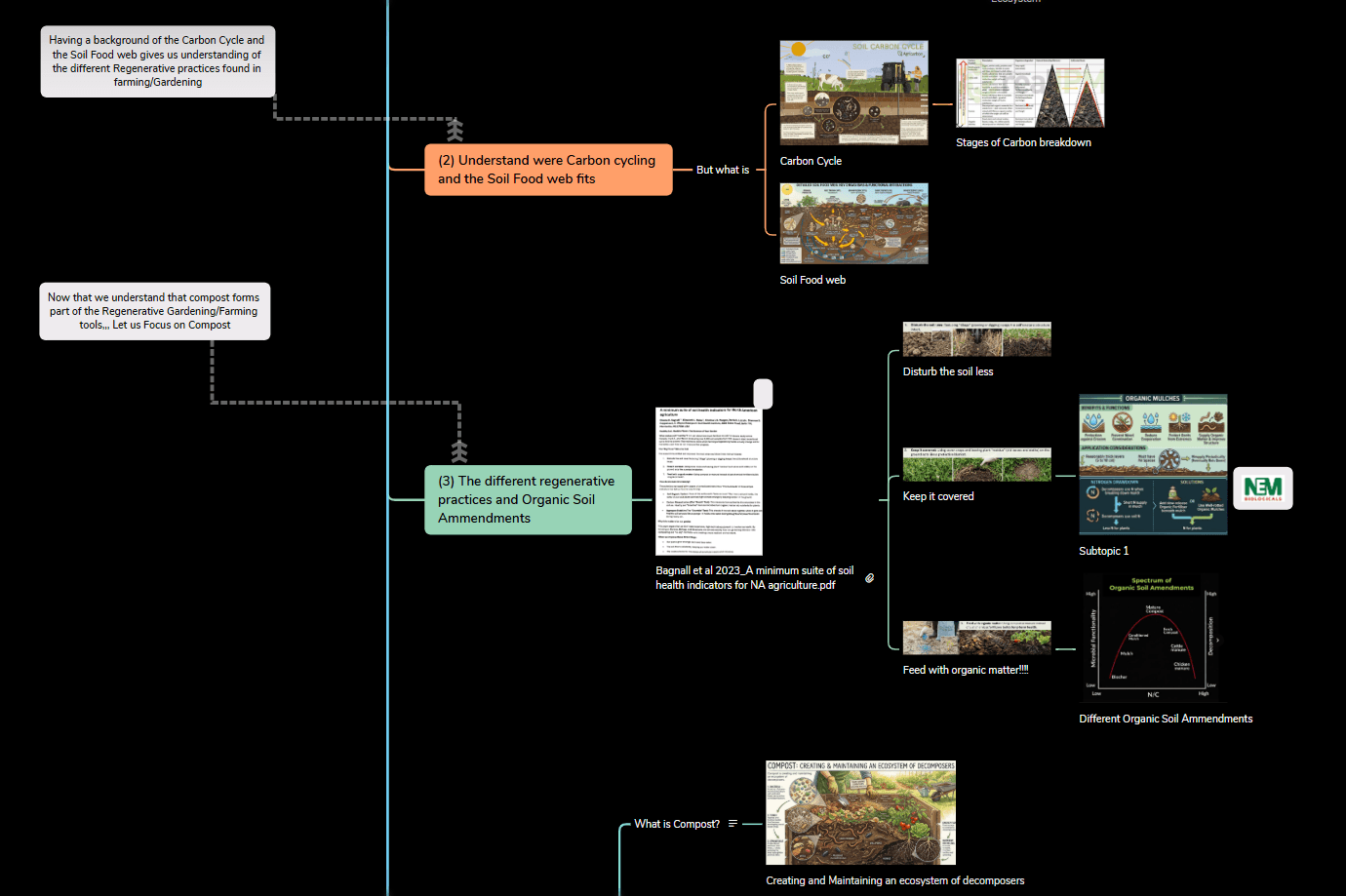
It felt strange not to stay up the entire night before the workshop. But it also felt right. I was not starting from zero or fighting with my own thoughts. I was presenting from the same structure I had used to understand the subject.
Outliner and Pitch Mode stand out to me because they help connect thinking, studying, and sharing. But their real value is more personal: they let me work in the way I naturally understand information.
Learning in my own way again
I still have one of my mother’s old mind maps from a course she wrote about 30 years ago. Looking at it now, I can see how deeply her way of teaching shaped me. Xmind feels like a modern continuation of that gift.
It has helped me return to studying and enjoy learning again. More importantly, it has reminded me that the problem was never that I could not learn. I simply needed a way of learning that worked with the way my mind thinks.