One symptom, many paths: How Pranesh makes clinical thinking visible

hannah

In one of Pranesh Balasubramaniam’s teaching sessions, a student admitted that the material felt overwhelming.
It was a familiar problem in medical education. Students need to understand a large body of knowledge, but presenting everything at once can make it harder to see how symptoms, diagnoses, and decisions connect.
As an ophthalmologist and medical educator, Pranesh could not remove that complexity. Instead, he began looking for a way to help students find a clearer path through it.
If your own teaching begins with complex material, try Xmind to give learners a clearer place to start.
A student puts the real problem into words
Based in Edinburgh, Pranesh teaches medical students, residents, and nurses alongside his clinical work. He also shares educational videos with more than 40,000 subscribers on YouTube.
Across these different settings, he wants learners to understand the reasoning behind a clinical decision rather than simply memorize a list of facts. Yet the material he works with often arrives in a form that makes those relationships difficult to see.
A reference document may contain everything a student needs to know, but that does not mean the student knows where to begin. Important details compete for attention, and the connection between them can disappear across pages of text.
The feedback from Pranesh’s student clarified the challenge. Learners needed access to the complete clinical picture without having to process every part of it at the same moment.
For Pranesh, the question became: How could he show the whole picture while still giving students one clear place to start?
Finding a shape for complex knowledge
Pranesh had been drawn to visual thinking since his ophthalmology training in India. He experimented with whiteboards and online mind-mapping tools because they allowed related ideas to sit beside one another instead of being separated by slides or pages.
What he still needed was a workspace he could keep developing, return to offline, and use directly in a teaching session.
Around six years ago, he began using Xmind. The structure felt natural to the way he wanted to explain medicine. Symptoms could connect to possible diagnoses, each diagnosis could lead to further questions, and every detail could remain anchored to the larger topic.
This was more than a different way to arrange notes. It allowed Pranesh to design the order in which a learner encountered the information.
He could decide what students needed to see first, which details could wait, and how each new branch related to what they had already understood. The complete subject remained available, but it no longer had to arrive all at once.
The map becomes part of the lesson
Pranesh’s maps are not finished diagrams that students simply look at. They are built to be explored.
One learner, one branch at a time
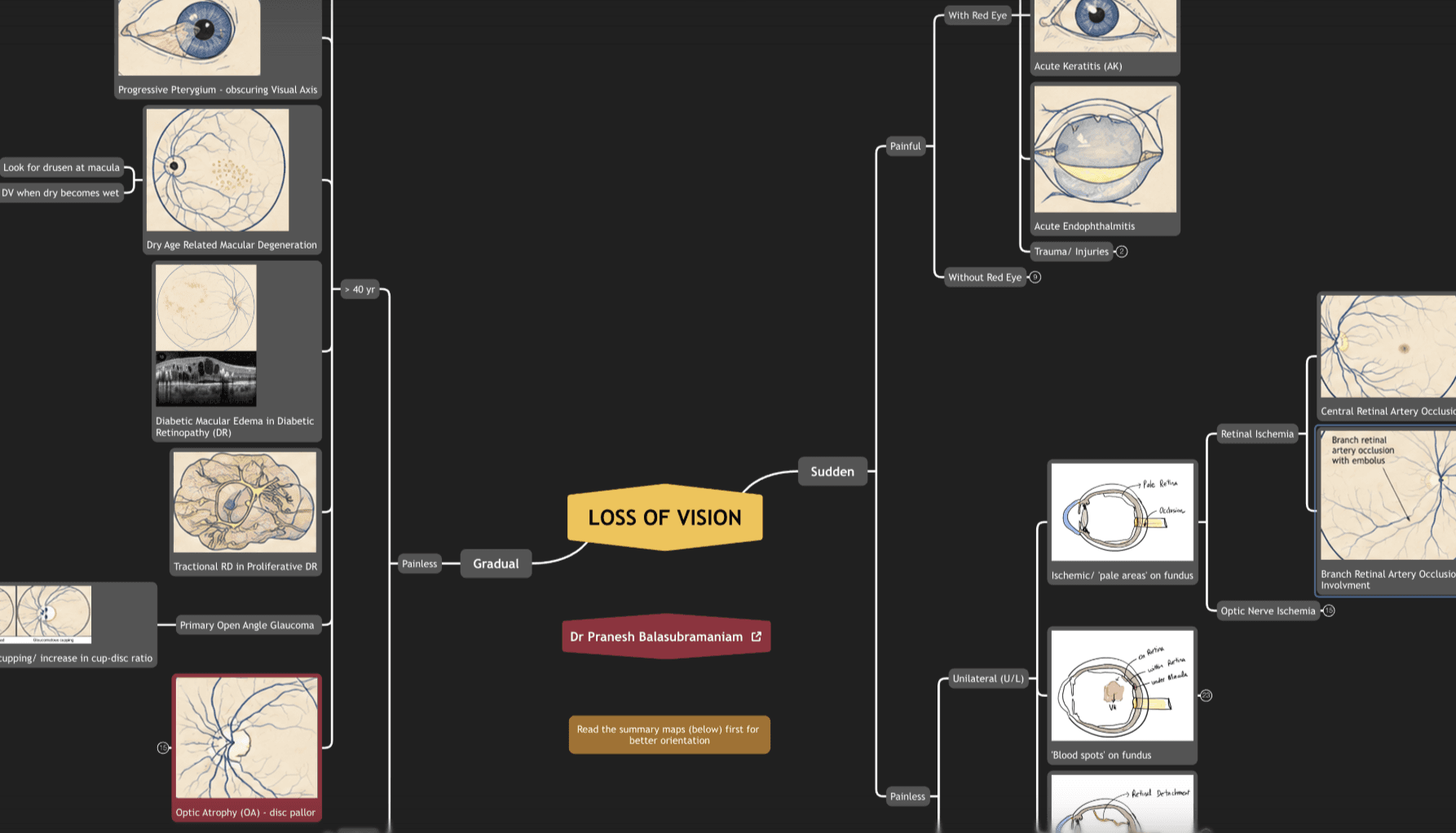
Consider a patient who arrives with a red eye. The symptom may point to several possible conditions, each with its own questions, warning signs, and next steps.
On a conventional slide, these possibilities can quickly become another dense collection of information. Pranesh instead arranges them as connected clinical paths.
Students can begin with the symptom, unfold one branch, and follow the reasoning behind it. When they need more context, they can return to the wider map and see how that path relates to the alternatives.
The process resembles the way clinical decisions develop in practice. Learners do not have to memorize the entire map before taking the first step. They can move through the problem one decision at a time while knowing that the whole structure is still there.
A presentation that preserves the connections
Pranesh also teaches directly from the map. He can begin with an overview, move closer to a specific branch, and then return to the complete structure as the discussion develops.
This movement matters because a clinical detail rarely makes sense in isolation. Students can see both the point being discussed and the context that gives it meaning.
When Pranesh presented his maps to medical colleagues in Edinburgh, the response encouraged him to continue. The approach was not only useful for students encountering a subject for the first time. It also offered experienced doctors a different way to examine familiar knowledge.
The same map can continue working after the teaching session. Pranesh records explanations on his iPad, develops them into longer lessons, and uses separate video tools to create shorter clips for his online audience. One carefully structured idea can travel from a live presentation to a video and then back into a student’s own learning process.
Technology can begin the map, but it cannot finish the lesson
Pranesh continues to explore how new technology can support his teaching. When he tried turning an image of his own material into a mind map with Xmind AI, he was impressed by how quickly it produced an editable structure.
What interested him was not the idea of receiving a finished answer. It was the possibility of beginning with a useful skeleton rather than a blank page.
That distinction is especially important in medicine. Pranesh cannot leave questions of accuracy or clinical judgment entirely to AI. He reviews the generated structure, corrects the content, reorganizes the branches, and adapts the material to the people he is teaching.
The technology may provide a starting point, but the educator remains responsible for deciding what the lesson should say and how the learner should move through it.
The whole picture, one step at a time
Pranesh’s maps do not make medicine simple. They make its logic visible, allowing students to move through a difficult subject one symptom, one decision, and one branch at a time—without losing sight of the whole clinical picture.
For Pranesh, this is the value of Xmind: it helps him preserve the depth of medical knowledge while making its structure easier to follow. Build your next lesson with Xmind and give learners a clearer path through complex knowledge.