Who to target, what to say: build buyer personas with Xmind

Hannah

Buyer personas are useful when they help you choose an audience and shape a message. In Xmind, compare buying roles in a Matrix, then use a detailed mind map to connect customer needs with messaging and proof.
This guide draws on Eric Bouchet's project management software case to show how that works. Bring your research notes and start mapping your buying roles in Xmind as you follow along.
Compare buying roles before building detailed profiles
A useful buyer persona explains someone's part in a purchase, not just their job title. In a B2B software campaign, the person experiencing the problem may not be the person approving the spend. Your message needs to reflect that distinction.
Separate roles when they change the buying conversation
In an Xmind webinar, coach and consultant Eric Bouchet illustrated the buying group with three roles: an agency director who pays for the software, a project manager who uses it day to day, and the people who receive and complete tasks. These roles gave the team a way to discuss different relationships with the same product.
The practical question is whether a distinction changes your approach. If two people need different evidence, have different authority, or would take different next steps, keep those differences visible. If several job titles describe the same buying role, you may be able to group them.
Start by identifying who experiences the problem, evaluates a solution, approves the purchase, and uses the product. Do not assign motivations from the title alone. A director's priorities and a project manager's frustrations still need evidence from the people you want to reach.
Separate what you know from what you decide
Eric's strategic map combined customer information with business decisions. Its categories covered roles, pain points, buying criteria, discovery channels, and position in the decision process. He also added value proposition and priority: what the company would communicate and how it would act on the information.
That distinction matters. “This role needs approval from finance” is a research finding if a source supports it. “We will create a business-case page for this role” is your team's response.
As Eric put it, “Value proposition is about what we tell them.”
In your own map, keep sources close to the observations they support. Identify assumptions as assumptions, and record targeting or messaging decisions separately. An agreed priority is a business choice—not evidence that every customer in that group behaves the same way.
Choose who to target for your next campaign
A priority ranking needs a purpose. Before deciding which persona comes first, name the action your campaign should encourage: starting an evaluation, requesting a demo, or bringing an approver into the conversation.
The most senior buyer is not automatically the best first audience for every campaign. Choose the role that has a credible reason and ability to take the next step you need.
Compare candidates against the same criteria
Building on Eric's inclusion of a priority field, use these questions to make your own targeting decision:
Problem fit: Do you have evidence that this role faces a problem your product can address?
Ability to act: Can this person take the campaign's next step or involve someone who can?
Reach and proof: Do you know where to reach them, and can you support the message with a relevant demonstration, example, or customer result?
Write a short reason under each criterion. Where evidence is missing, mark the gap instead of giving the persona a confident score. A promising role with uncertain buying influence may need another interview before a larger campaign commitment.
Finish with a decision that another team member can use: the primary audience, the action you want, why that audience comes first, and which other roles need supporting material.
Choose a first audience without ignoring the buying group
Consider an illustrative project management software campaign—not a reported finding from Eric's project. Suppose your interviews show that project managers struggle to spot delayed handoffs and can arrange product evaluations, while agency directors approve purchases.
For a campaign aimed at starting evaluations, project managers could be the first audience. Directors would still need a supporting business case before purchase. The resulting brief might read:
Prioritize project managers for an evaluation campaign because they experience the handoff problem and can initiate a review. Prepare supporting material for the director's approval decision.
If your research instead shows that directors initiate all evaluations, the priority should change. The map makes the reasoning reviewable; it does not replace the evidence needed to choose.
Turn the chosen persona into a message you can support
Once you know whom to address, the next task is deciding what deserves space on the page. A persona should help you choose the opening message, the evidence beneath it, the objection to answer, and the call to action.
Expand the details that change the copy
Eric used a second mind map as a master framework for deeper persona information. It included problems, frustrations, objections, customer language, preferred channels, tone, key messages, and storytelling approaches.
This was a framework for assembling richer profiles, not proof that every field already contained verified customer information. Its value for a writer is the set of questions it makes visible.
For your chosen persona, gather the details that affect this particular piece of content:
What situation makes the problem worth addressing now?
How do customers describe it in their own words?
What would they need to see before believing your claim?
What concern could stop them from taking the next step?
Keep source wording distinguishable from your interpretation. If a supposed customer quote is actually your summary of several conversations, present it as a summary.
Build a brief before writing a polished headline
Continuing the illustrative software example, assume your research supports the handoff problem and your product can demonstrate the relevant workflow. Here is how persona information could shape a landing page:
Persona input | Decision for the page |
|---|---|
Project managers need to identify delayed handoffs. | Lead with visibility into handoffs, not a broad promise to “transform teamwork.” |
They need to understand whether the workflow fits their team. | Show a realistic handoff example with ownership and status visible. |
They can initiate an evaluation but cannot approve the purchase. | Offer an evaluation step and material they can share with the approver. |
Approval requirements remain unclear. | Research those requirements before claiming that the page addresses the full buying decision. |
A draft headline might be “See where project handoffs stall.” A matching call to action might be “Explore the handoff workflow.” Both are illustrative copy for the hypothetical software product, not claims about Xmind or results from Eric's case.
The important connection is between the problem, the promise, and the proof. If the product cannot demonstrate what the headline promises, revise the message. If you cannot explain why the next step suits this audience, revisit the persona.
Before handing the brief to a writer, check that every major message has a reason to be there. Remove profile details that do not affect the content, and leave unresolved questions visible.
Build and review the persona maps in Xmind
You now have two concrete outputs to build: a comparison that explains your targeting choice and a detailed brief that explains your messaging choice. Keep them connected, but do not force them into one oversized profile.
Create a compact comparison, then expand the chosen role
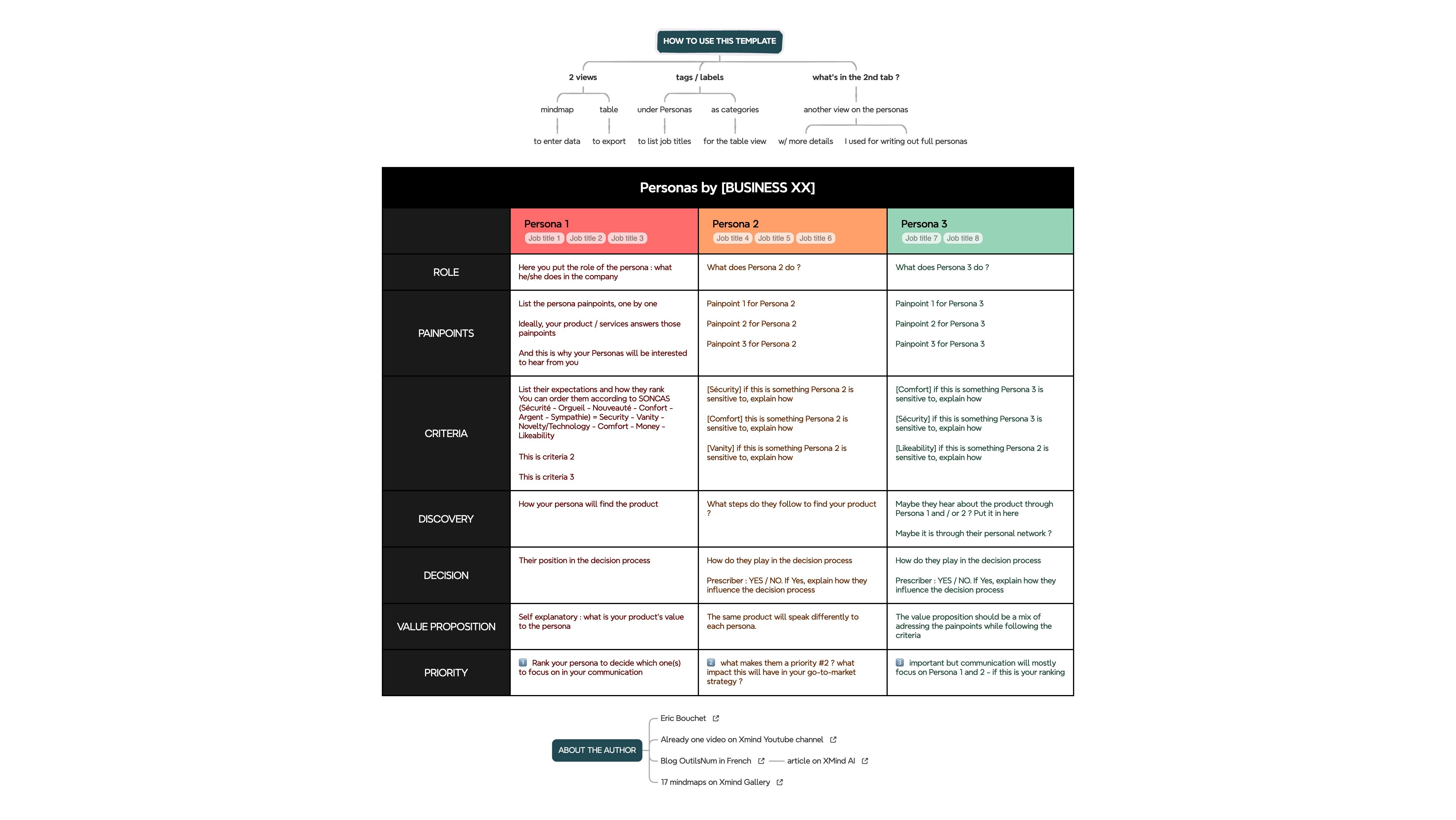
Start with the B2B Customer Persona Analysis template shared with the webinar, replacing its example content with your own findings.
Adapt the categories to the purchase you are studying.
To recreate the comparison approach:
Give each buying role a Main Topic.
Add short observations beneath each role.
Apply consistent Labels such as “Pain points” and “Buying criteria” to the relevant observation topics.
Use the Matrix structure to compare matching categories, then check that observations appear in the intended rows.
Labels group Subtopics in a Matrix; an ordinary nested outline may need restructuring to produce a clean comparison. Xmind's Matrix explanation illustrates this relationship between topics, labels, and headers.
Keep the strategic map brief enough for a review meeting. Eric's working example contained five personas, and he aimed to keep the overview readable on one A4 page. That was his working constraint, not a required number of personas or a universal page limit.
For the audience you select, build a separate detailed map containing the research, messaging brief, supporting proof, and open questions. Use the same role names across both maps so readers can follow the connection.
Use AI to organize material, then review the claims
Eric exported his strategic map and detailed framework as text for external AI tools, then reviewed the resulting material for use in website copy, landing pages, email sequences, and other content. He did not use Xmind AI to create the original maps.
His workflow also allowed AI to expand beyond the supplied information. For your own evidence-based brief, apply a stricter rule: keep sourced findings separate from suggestions, and leave unknowns unresolved rather than turning plausible additions into customer facts.
A useful instruction is: “Organize the supplied findings under these persona fields. Keep source references, list unsupported ideas as hypotheses, and mark missing information as unknown.” Review the output against the original material before using it in a campaign.
Check the decisions before sharing the reference
Ask a colleague to read the maps and explain whom the campaign addresses, why that person comes first, what the page should say, and what evidence supports it. If they need you to reconstruct the reasoning verbally, clarify the maps.
Eric exported his strategic map as a PNG and shared it as a company reference. You can likewise share a reviewed snapshot while retaining the editable working map. Add a review date and record important changes so the team knows which decisions are current.
Team agreement makes the reference usable. Customer research and subsequent campaign evidence determine whether its assumptions hold.
Conclusion
Buyer personas become useful marketing tools when they connect customer evidence to audience priorities and messaging choices. Eric Bouchet's two-map approach keeps those decisions manageable: a compact Matrix supports comparison, while a detailed mind map provides the context for writing. Neither format replaces customer research, but together they give teams a way to organize what they know and see what still needs checking. For your next campaign, build a persona map in Xmind and turn that understanding into a clear targeting and messaging brief.
FAQs
1. Can I start if I have only a few customer conversations?
Yes, as a provisional map. Record whose experience each observation represents and avoid generalizing it to the whole market. Use the gaps to plan the next conversations, particularly where uncertainty affects targeting or the message you intend to publish.
2. Should every job title have its own persona?
No. Split profiles when differences in needs, authority, or buying behavior change your approach. Several titles can share a persona if they play the same role in the purchase. Conversely, one title may cover people with meaningfully different responsibilities.
3. Does each persona need a separate landing page?
Not necessarily. Create a distinct page when an audience needs a different promise, proof, or next step. If those remain the same, a shared page may be sufficient. Let the messaging brief reveal the difference before multiplying pages.
4. What if sales and marketing disagree on the priority?
Compare the situations behind their evidence. Sales may be describing late-stage approvers while marketing is focused on people who initiate evaluations. Name the campaign stage, review the relevant sources, and turn any remaining disagreement into a specific research question.
5. When should I update the maps?
Update them when new evidence changes a decision: who initiates evaluation, what blocks approval, which problem matters, or what proof customers need. Revisit the targeting choice when the campaign goal changes, even if the underlying buying roles remain the same.
Turn buyer insights into clearer messaging
Use Xmind to compare buying roles, prioritize your audience, and shape messages around customer needs.