Mind mapping for note-taking: Build one course map that keeps growing

Hannah
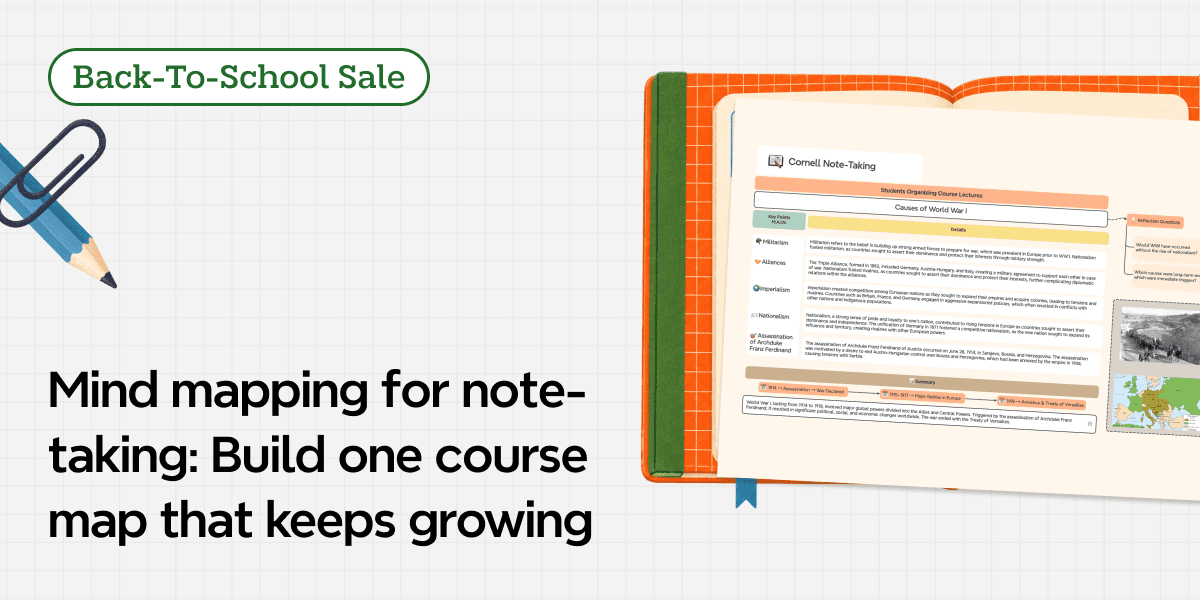
Mind mapping for note-taking turns the half-sentence typed during a lecture, the photo of the whiteboard, and the question left in the margin into connected knowledge you can keep refining. With Xmind, those fragments can become one course map that grows across the semester.
You do not need to perfect every branch while the instructor is already moving to the next slide. Capture first. Then return after class, when you have room to decide what belongs together and what still does not make sense.
Open Xmind after your next class and give each new idea a clear place in a course map you can keep building.
The real note-taking problem begins when the lecture ends
The hardest part of note-taking is not recording the lecture. It is making sense of what you recorded once class is over. A page packed with words can feel reassuringly complete, but look closer and the gaps appear: Which concept is central? Which example actually explains it? Where do two theories disagree? The information has been recorded. The thinking is still unfinished.
The difficulty grows when course material arrives in several formats at once. The lecture adds an explanation that is not on the slides. The slides carry a diagram that is not in the textbook. Class discussion raises a question that appears nowhere else. If those pieces remain separate, you must locate and compare them before the real studying can begin.
Mind mapping for note-taking makes relationships explicit. It gives each concept a place in a hierarchy while allowing examples, questions, comparisons, and links to branch from it. The purpose is not to make notes look more visual. It is to turn captured material into a navigable model of the subject.
Use a three-pass mind-mapping workflow for lecture notes
Use these three passes as a flexible starting point. A seminar, laboratory, language course, and history lecture may need different structures, so keep the purpose of each pass while adapting the map to the material.
Pass 1: Capture the lecture while it is moving
During class, prioritize meaning over presentation. When the instructor jumps from a definition to an example, catch both. Record the lecture's main questions, key terms, evidence, and anything repeated for emphasis. If something is unclear, leave a question on the branch instead of losing the next five minutes trying to solve it.
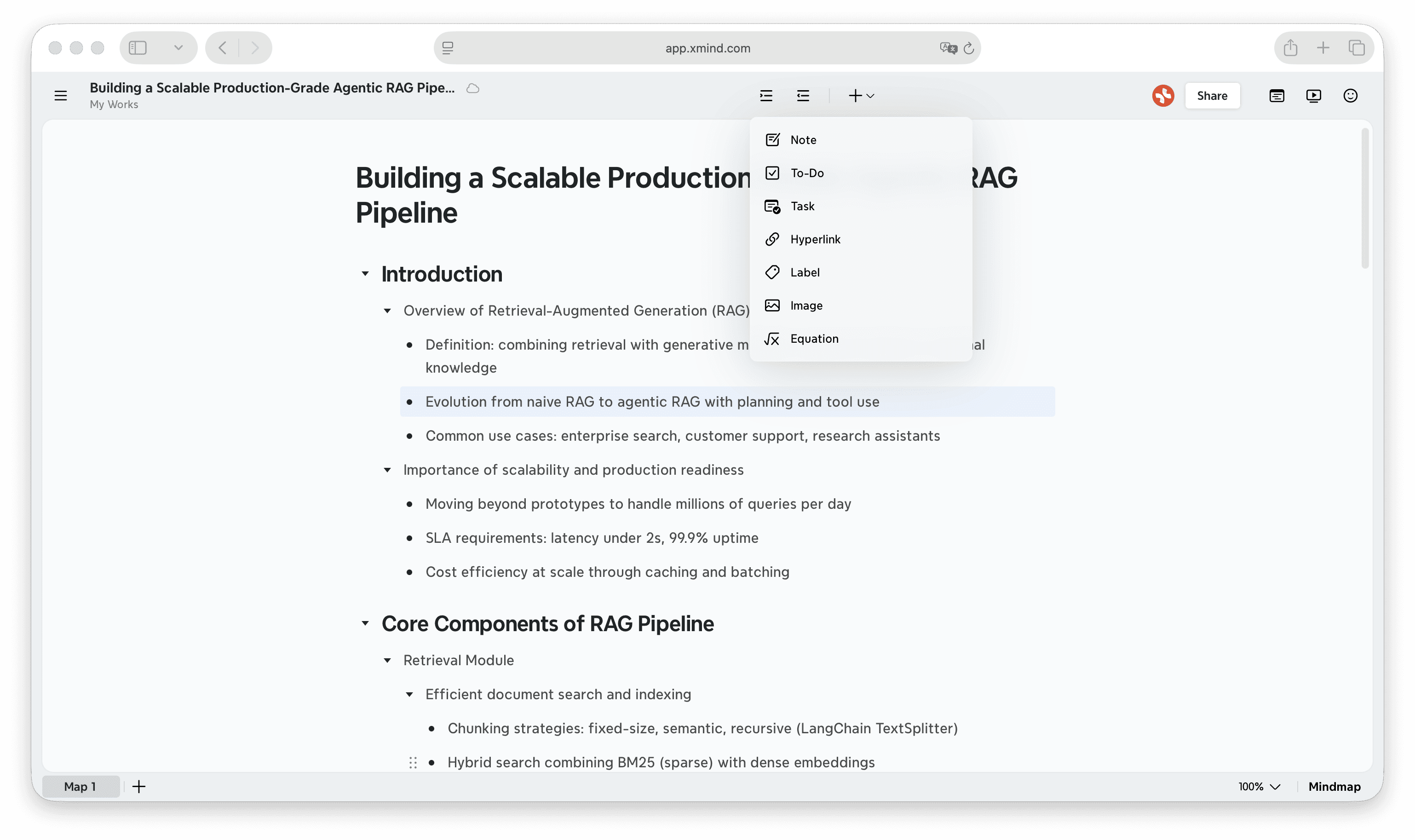
If you think more comfortably in a linear list while listening, Xmind's Outliner lets you work with the same content as an outline and switch back to a mind map. That makes it possible to capture points in sequence first, then inspect their hierarchy and relationships later.
Keep this pass light. Abbreviations, unfinished phrases, and temporary branches are allowed. Your notes need to keep pace with the room. They do not need to look ready for publication.
Pass 2: Make the lecture reveal its shape
Soon after class, reopen the map and make the lecture reveal its logic. Merge repeated points. Drag an example beneath the concept it clarifies. Pull a main claim away from the details supporting it. If the instructor presented a process, use stages. If the lesson compared theories, organize them around shared criteria. If the course develops one argument over time, show what this lecture changed.
This is the moment messy notes begin to become a knowledge structure. You are no longer copying the lecture. You are deciding what it means. Those decisions matter more than matching colors or making every branch symmetrical.
Add short notes when a topic needs explanation, and preserve source links where a claim must be checked later. Use labels or markers only when they communicate a meaningful distinction, such as "exam focus," "unclear," "example," or "connect to previous lecture."
Pass 3: Find the branches that do not hold up yet
Once the lecture has a clear shape, inspect its weaker branches. Look for a key term without an example, a conclusion without supporting reasoning, or two similar concepts without a visible difference.
Grow Ideas can expand a selected topic or subtopic and suggest additional angles. In a study workflow, use those suggestions to generate questions, possible examples, or directions for further reading. Keep a visible distinction between course material, your interpretation, and suggestions generated with AI, then check every addition against course materials or reliable sources before treating it as part of the knowledge map.
The goal is not to grow the largest map. It is to find the branch that would collapse if you had to explain it aloud, while there is still time to ask a professor, reopen a reading, or compare another source.
Bring the whiteboard photo back into your notes
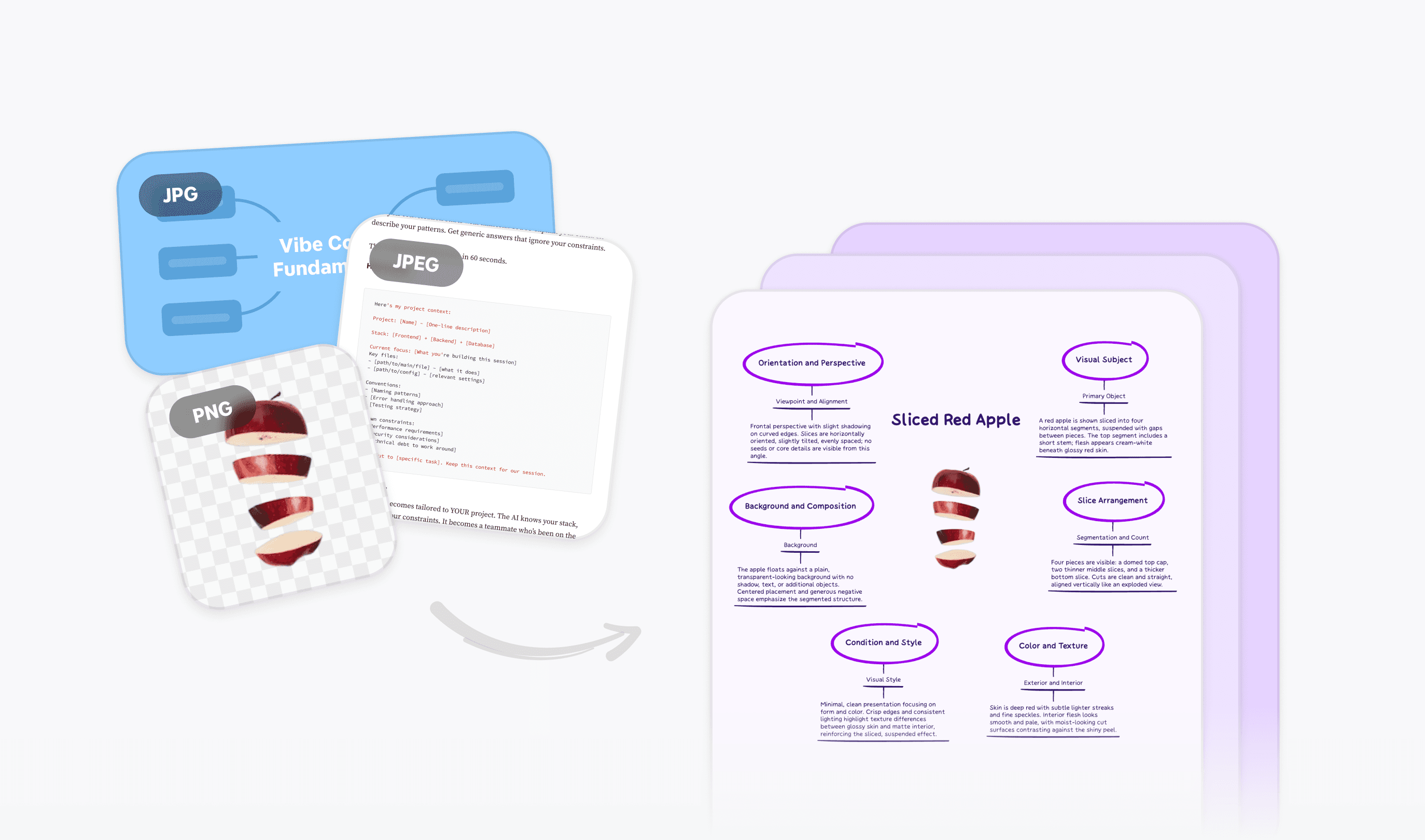
Not all notes begin as text. Sometimes the most useful explanation leaves class as a whiteboard photo in your camera roll. A screenshot preserves the process diagram. A printed chart carries the annotations. The information is still there, but it cannot yet be reorganized or connected to the rest of the course.
Image to Mind Map can analyze a photo or screenshot and turn its content into a structured, editable mind map. This creates a useful starting point for diagrams, slide screenshots, and clearly photographed notes without requiring every label to be typed again.
The generated map still needs your review. Check labels against the original image, correct the hierarchy, and add the classroom context that the image alone cannot contain. Dense or handwritten notes may need manual correction. Conversion should remove transcription work, not remove judgment.
After reviewing the result, place the converted structure inside the relevant course map. The whiteboard photo is no longer an isolated image you may never open again. It now sits beside the theory, reading, or assessment that gives it meaning.
Watch one course knowledge map grow with the semester
Keep one main knowledge map for each course rather than a separate polished map for every lecture. A map per lecture can look organized while leaving the course in pieces. In one course map, branches hold the major modules, questions, methods, or themes, and each new lecture joins the branch it extends rather than becoming another isolated file.
Then let the structure change as your understanding changes. An early branch called "Key terms" may split into theories, cases, and methods. Two lecture branches may move together when their relationship finally clicks. A question from week two can stay visible until a later unit supplies the missing piece.
Use Outliner when you need to scan definitions or reorder points as a list. Return to the mind map when you need to see the larger pattern. The ability to move between these views supports different thinking moments without duplicating the content.
Close the branches and see what you can rebuild
A knowledge map becomes more useful when you stop simply scrolling through it. Before opening a branch, try to recall what should be there. Explain how two concepts connect, rebuild a process from memory, or answer the question you left after class. Then reveal the branch and compare it with what you reconstructed.
Before an assessment, avoid expanding every branch at once. Focus on one module, a group of related concepts, or a question the course repeatedly returns to. Use the map to move between the overview and the details that support it.
If a branch remains difficult to explain, that is useful information. The map has pointed to the exact place where your understanding is still incomplete. Return to the original material, revise the relationship, and make that branch stronger.
Conclusion
Strong notes are not defined by how much text they hold. They become valuable when you can see what matters, where ideas connect, what remains uncertain, and how the next lecture redraws the larger picture.
Capture quickly, reorganize deliberately, and question the structure before adding more. Use Outliner when linear thinking helps, Image to Mind Map when course material is trapped in a static image, and Grow Ideas when a branch needs new questions or directions. Keep the final judgment with the learner.
Build your next course knowledge map in Xmind, then give every new lecture somewhere meaningful to land.
Make every lecture build on the last
Use Xmind to connect new ideas with what you already know and create a study resource that grows all semester.