















Xmind Skill & CLI
Xmind Skill & CLI brings the right sources together in one workflow, giving your AI agent the tools and mapping know-how to deliver clear, editable local Xmind files.
What is Xmind Skill & CLI?
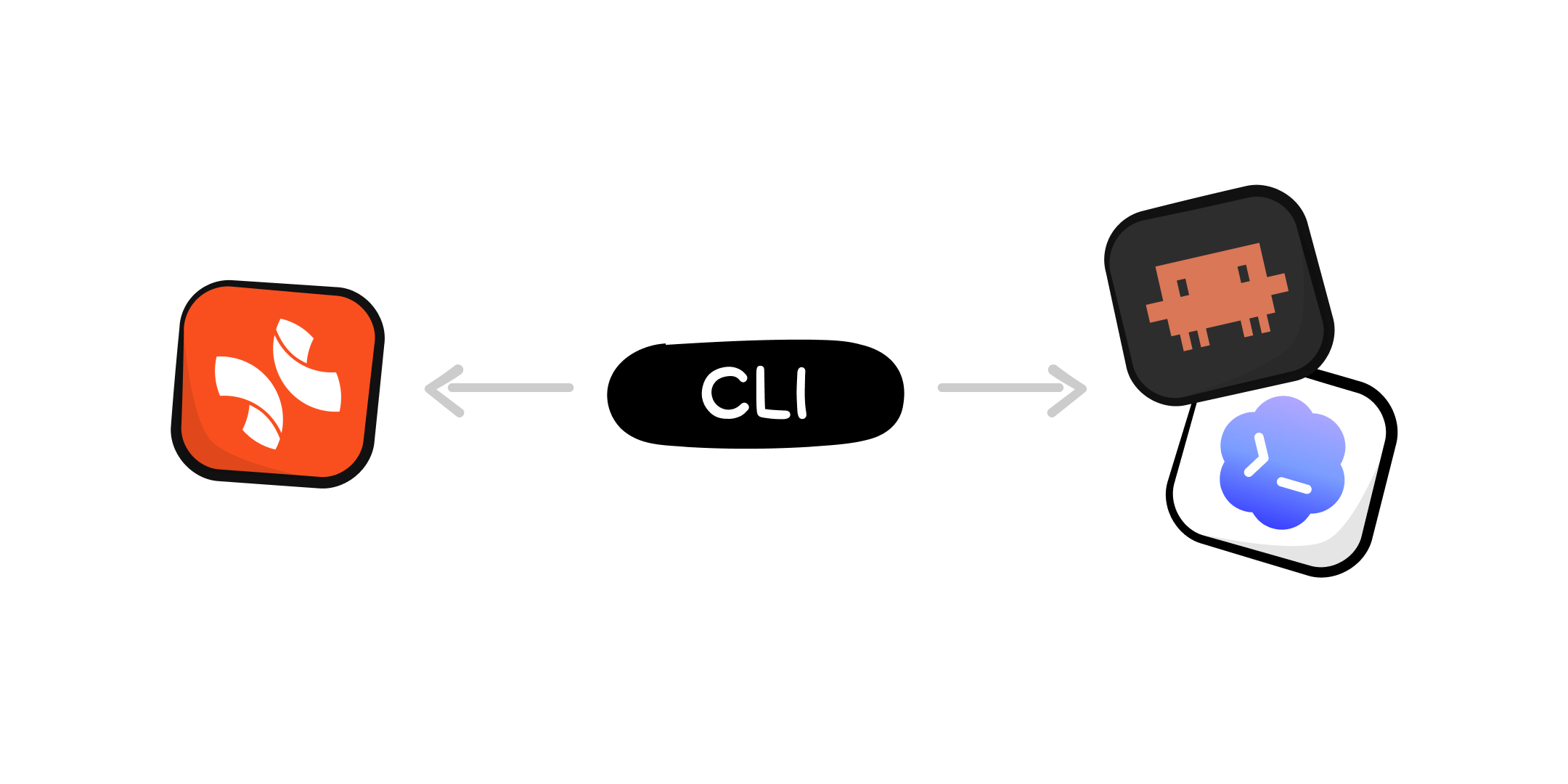
Xmind Skill & CLI brings Xmind’s visual thinking capabilities to AI agents such as Codex, Claude Code, Cursor, and OpenCode. Xmind CLI lets your agent create, read, edit, and check native local .xmind files, while Xmind Skill helps it organize content, choose the right structure and theme, and highlight what matters.
Give your agent a goal and source material—from documents and webpages to images, code, or connected apps—and it can produce a structured, editable Xmind file. Xmind Skill brings Xmind’s accumulated product experience, visual design thinking, and tested mapping practices into the workflow. Instead of applying structures and themes at random, it helps your agent organize content, choose an appropriate visual structure, and use emphasis according to the task.
Why use Xmind Skill & CLI?
-
Bring sources together across your Agent ecosystem — Combine local files, web content, and content from connected apps such as Notion and Slack in one mapping workflow.
-
Apply proven Xmind mapping practices — Built on Xmind’s product experience, visual design thinking, and real-world validation, the Skill helps your agent organize content and choose an appropriate structure, theme, layout, and visual emphasis.
-
Create editable local files — The result is a native
.xmindfile that you can open, revise, archive, or share. -
Check quality before delivery — The Skill reviews content structure and visual presentation against clear criteria, while the CLI validates the
.xmindfile after creation or editing. -
Keep improving with new Xmind expertise — Xmind Skill will be updated with new use cases, structural methods, and visual practices, helping your agent handle more kinds of work and make better maps over time.
Install and connect Xmind Skill & CLI
Ask your agent to set it up
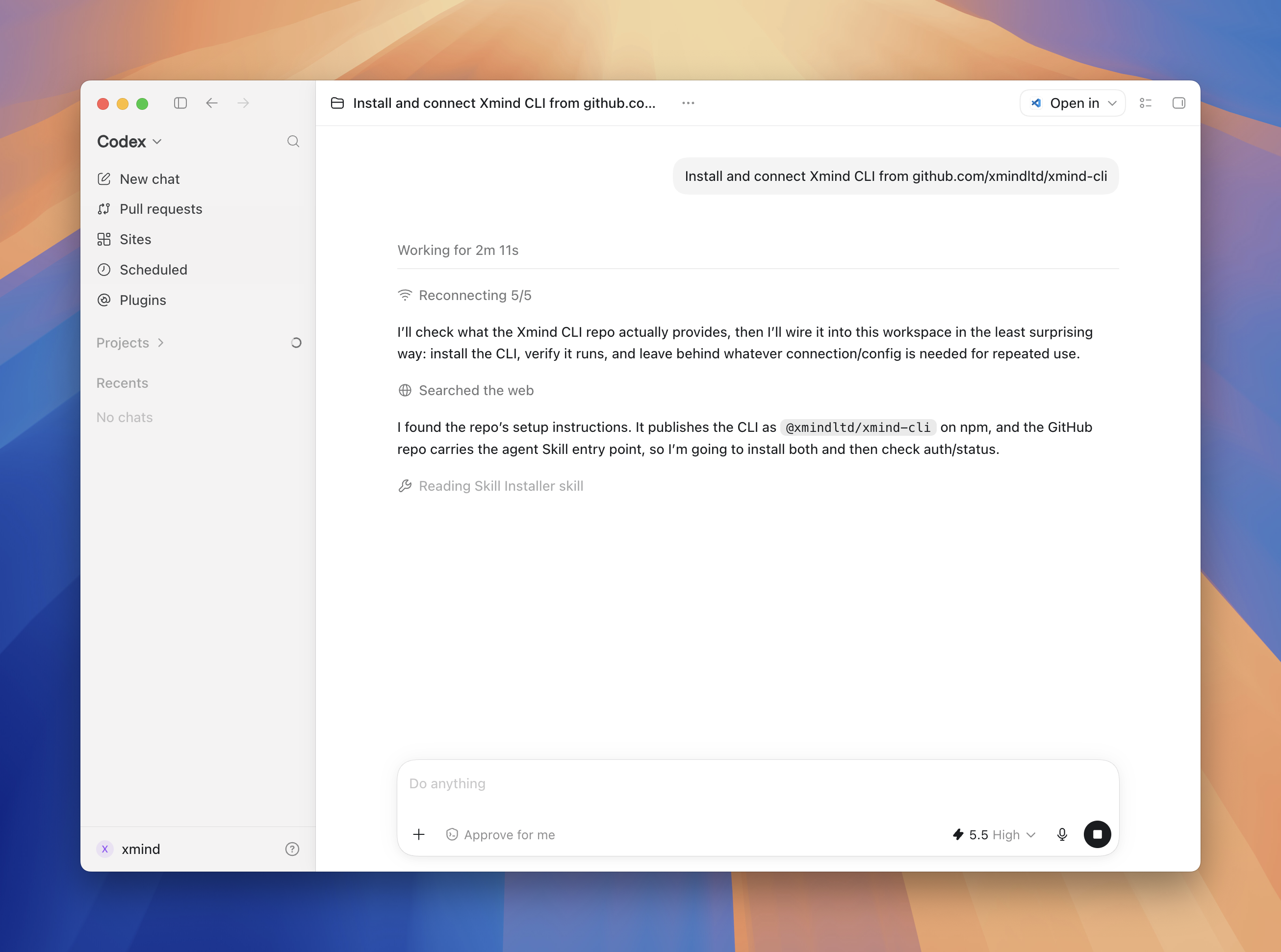
1️⃣ Open a supported AI agent, and tell the agent:
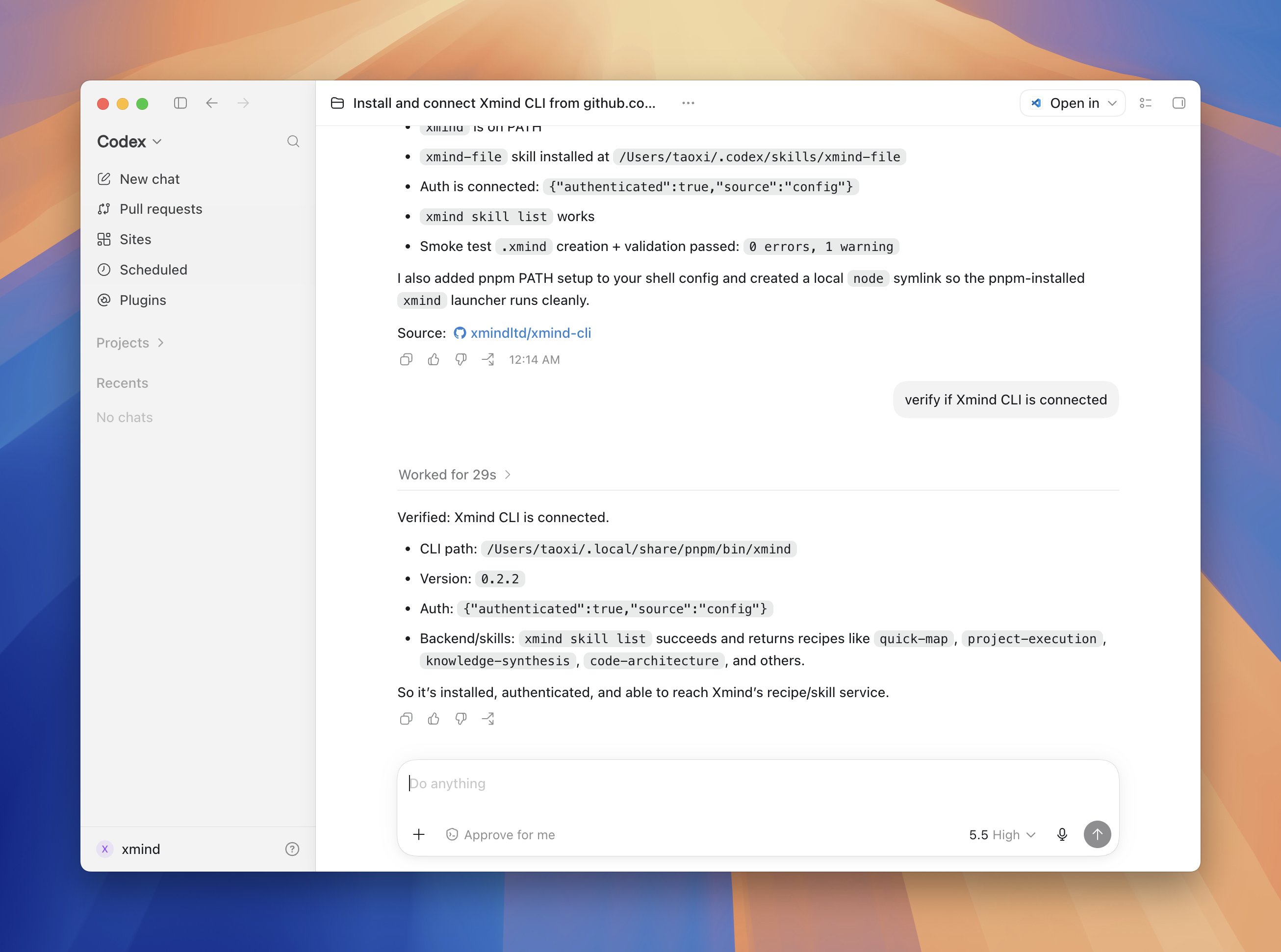
Install and connect Xmind CLI from github.com/xmindltd/xmind-cliThe agent will install Xmind CLI and the bundled Xmind skills.
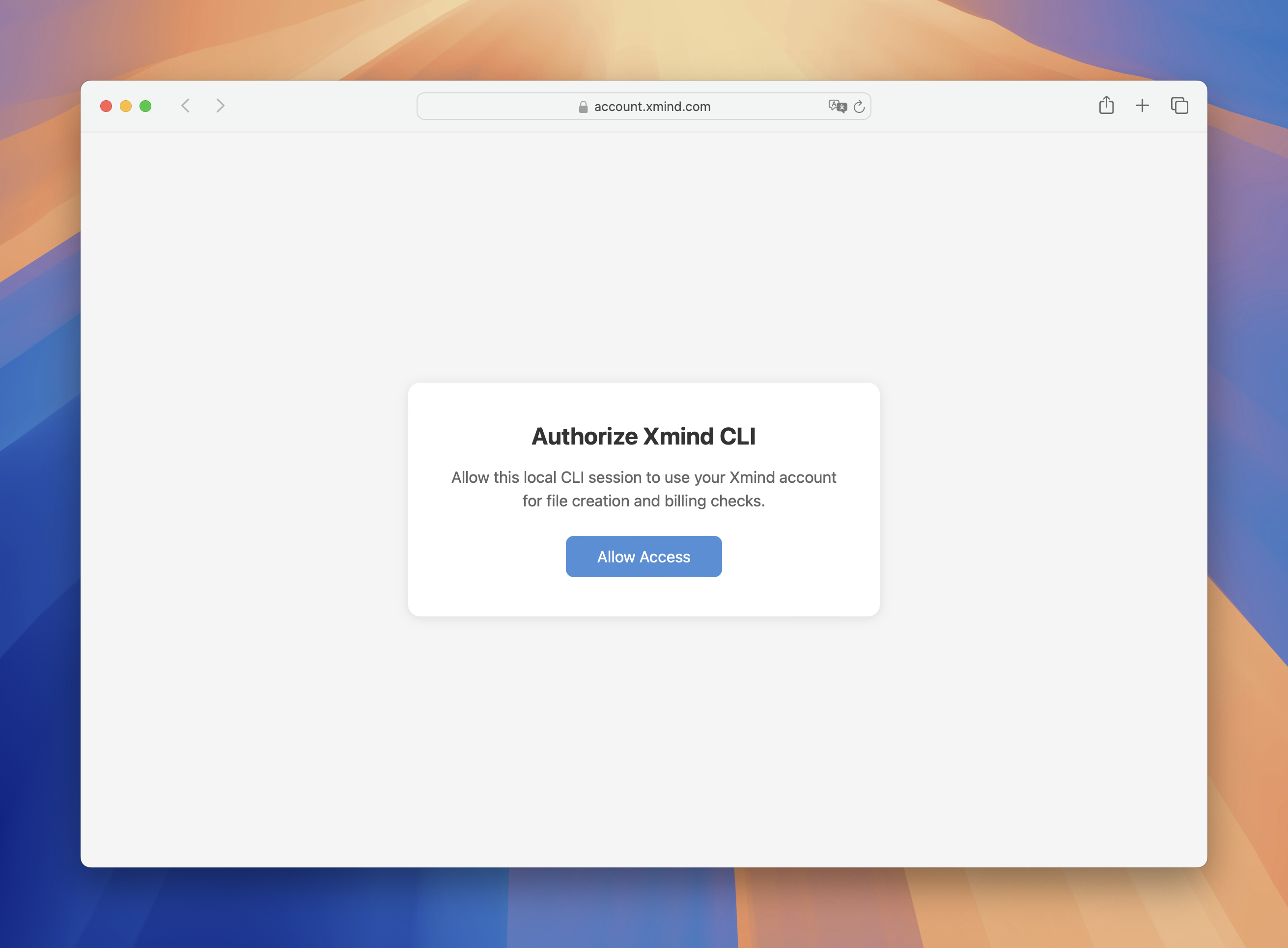
2️⃣ When the Xmind authorization page opens, sign in and confirm access.
3️⃣ Return to the agent and ask it to verify that Xmind CLI is connected.
Set it up manually
If your agent asks you to run the setup yourself, enter these commands in a terminal:
npm install -g @xmindltd/xmind-cli
xmind setup skills
xmind auth login
The final command opens your browser so you can authorize Xmind CLI with your Xmind account.
To check the connection later, run:
xmind auth status⚠️ Attention: Creating, reading, and editing .xmind files requires you to be signed in.
Create your first mind map
1️⃣ Give your agent the source material and a prompt that explains what the map should achieve, who will use it, and that it should be saved as a local Xmind file.
Your agent can use one source or combine several:
-
Direct input — Prompts, pasted notes, or rough ideas.
-
Local content — Documents, PDFs, spreadsheets, code, images, and existing
.xmindfiles. -
Web content — Webpages, articles, online documentation, and public image links.
-
Connected apps — Content from apps your agent can access, such as Notion, Slack, Google Drive, or GitHub.
For example:
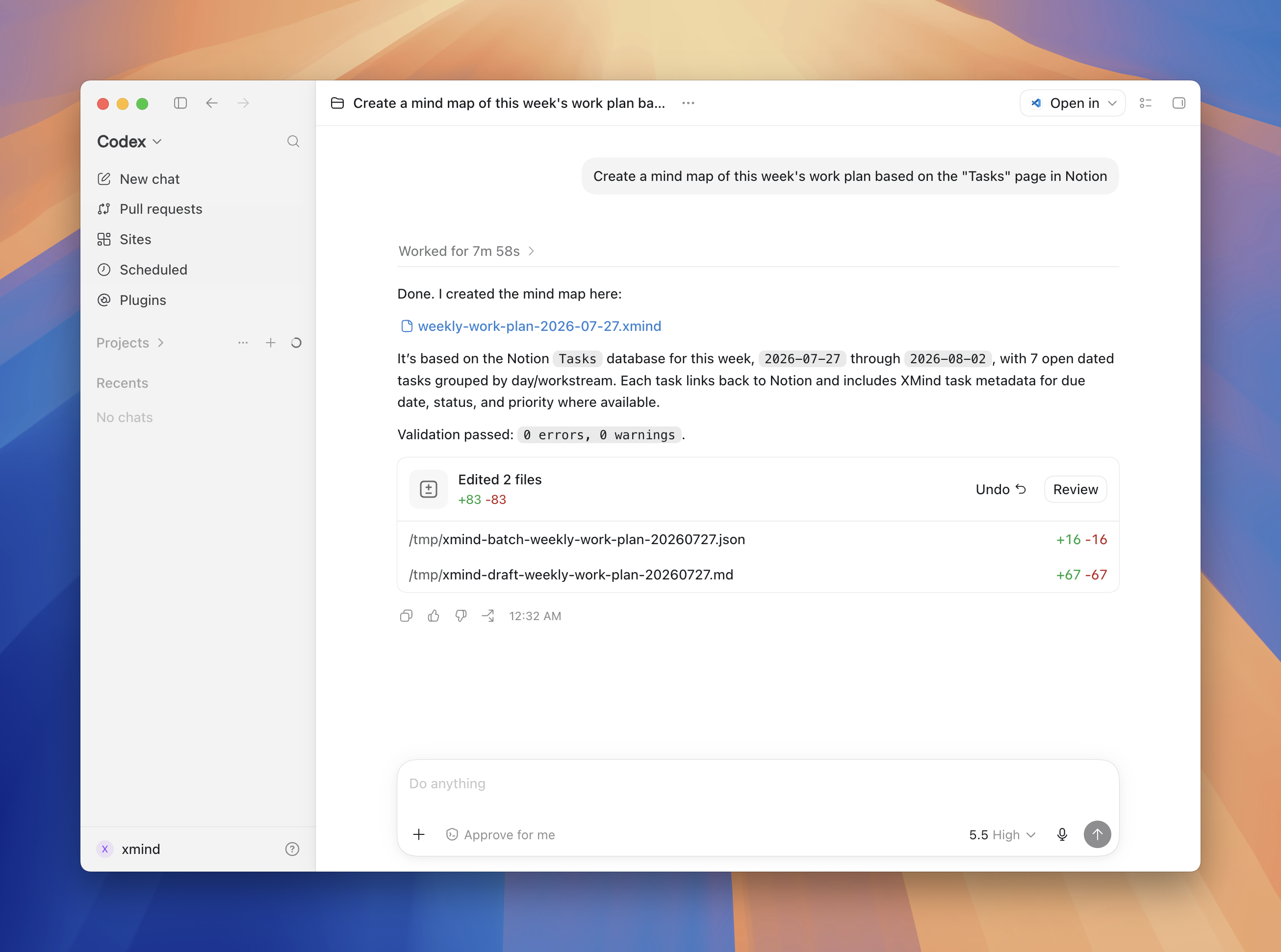
Create a mind map of this week's work plan based on the "Tasks" page in Notion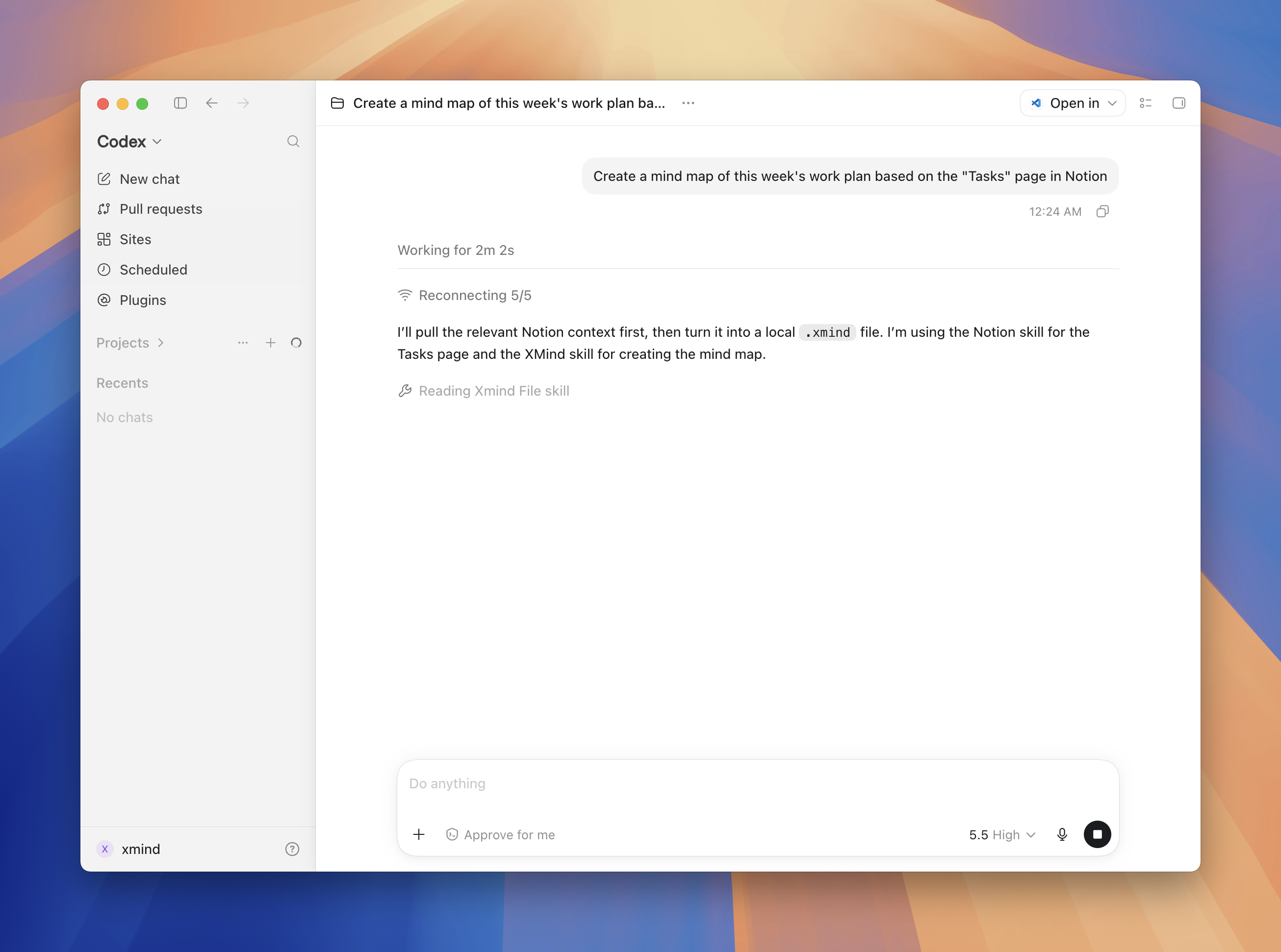
2️⃣ When the agent returns the file path and check result, open the .xmind file in Xmind to review or continue editing it.
Help your agent improve the result
Include these details in your prompt when they matter:
-
Purpose: Learn, plan, compare, present, decide, or review.
-
Audience: Yourself, a project team, decision-makers, customers, or students.
-
Depth: A quick overview or a detailed map.
-
Emphasis: Conclusions, risks, actions, evidence, chronology, or differences.
-
Visual direction: A preferred structure, color mood, or presentation style.
💡 Some richer map options may use Xmind credits. Your agent should tell you when credits are used. If the requested option is unavailable, Xmind CLI may create a lighter version and report the change.
Read, Edit and refine an existing mind map
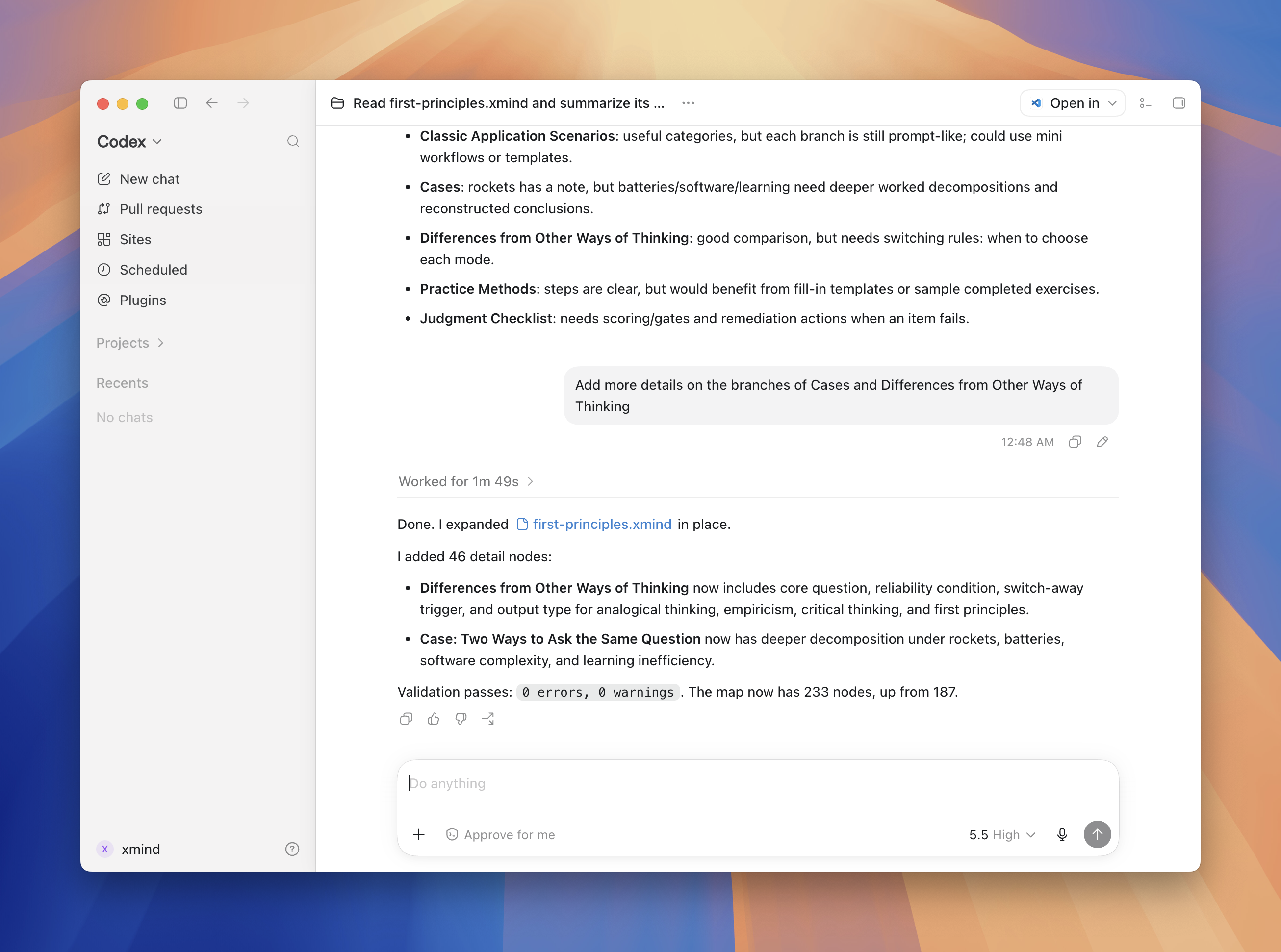
1️⃣ Give the agent the name of the local .xmind file, ask it to read or summarize the map, and tell it what you want to learn from the map, such as key decisions, risks, missing information, or next actions.
For example:
Read first-principles.xmind and summarize its structure. Identify the main decisions and branches that need more detail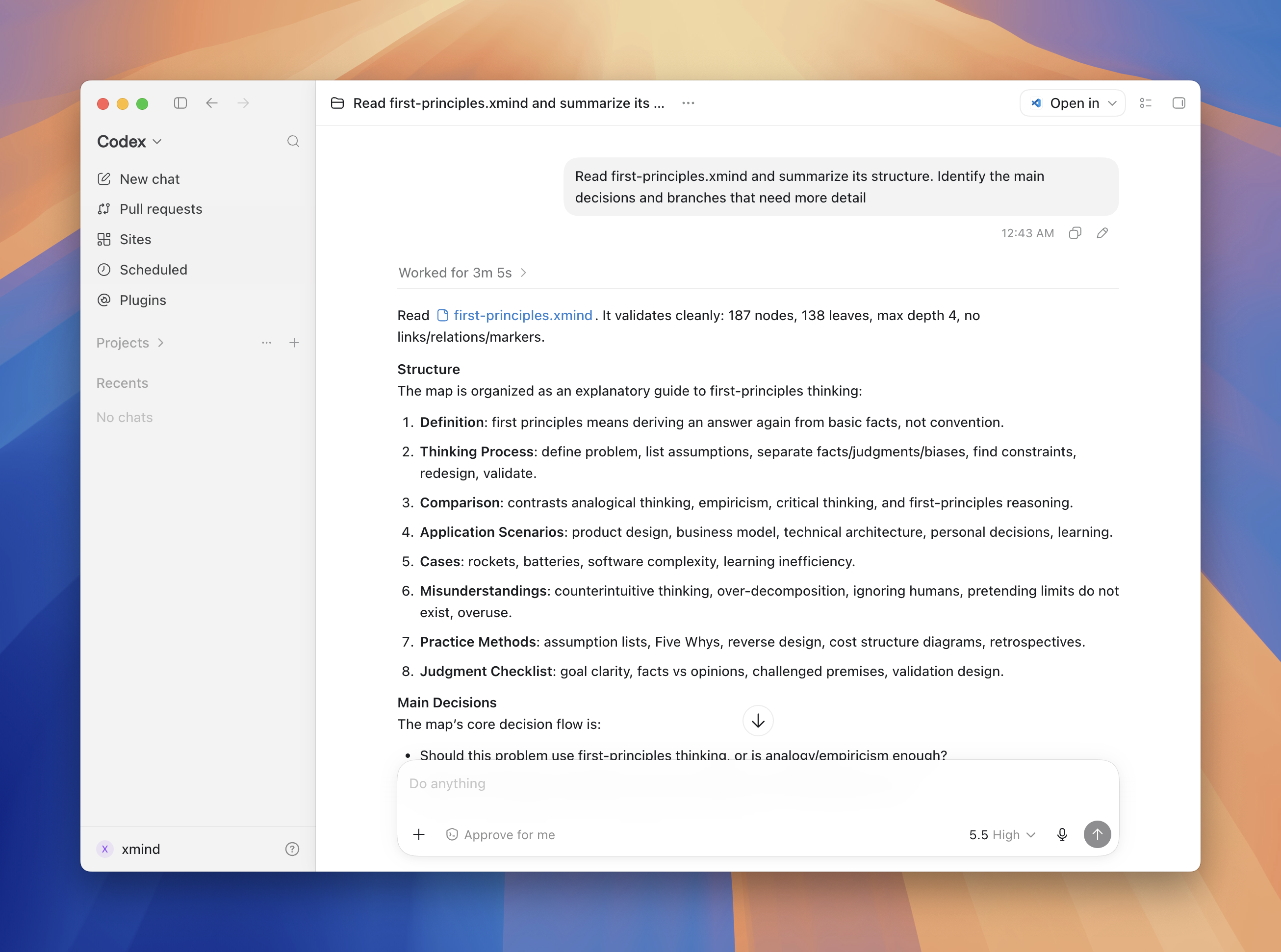
2️⃣ Give the agent the name of the local .xmind file you want to update, describe the changes in plain language.
For example, you can ask the agent to:
-
Add, rename, move, or remove topics.
-
Expand a branch with more detail.
-
Reorganize the hierarchy or change a local layout.
-
Update the theme or visual emphasis.
-
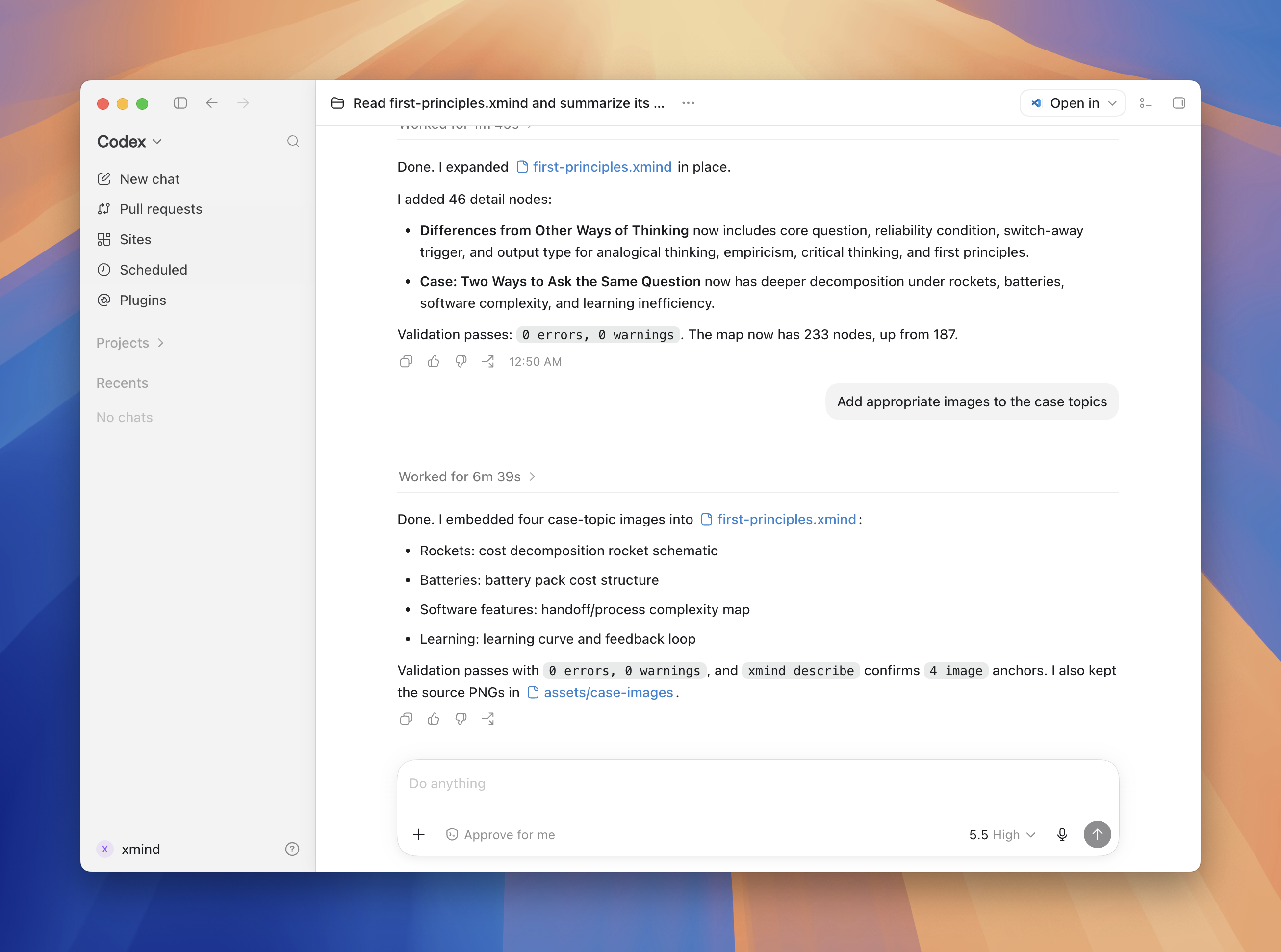
Add task information, labels, links, or images.
-
Work on a specific sheet in a multi-sheet file.
💡 Tip: If the file was already open in Xmind while the agent edited it, close and reopen the file to refresh the latest version.
Add images and links
Xmind Skill & CLI does not generate new images as part of its local-file workflow, but it can attach suitable existing images to the map.
Your agent can attach:
-
A local image you provide.
-
A suitable public image from the web, such as a PNG or JPEG.
-
An image from a Wikipedia page.
-
A webpage link.
-
A link to a local file.
⚠️ Attention: A local file link points to the file’s location on your computer. It may not work after the map is moved to another computer. Use a web link when the reference needs to remain portable.
What can you create with Xmind Skill & CLI?
-
Quick overviews — Extract the main ideas from a topic, article, webpage, or PDF and organize them into a clear, easy-to-scan structure.
-
Knowledge and research maps — Connect concepts, evidence, viewpoints, conclusions, and sources from books, courses, papers, reports, notes, data, or screenshots.
-
Project and execution maps — Turn ideas, task lists, meeting notes, whiteboard photos, and project documents into a view of context, decisions, priorities, risks, tasks, and next steps.
-
Comparison and decision maps — Compare product information, feature documents, spreadsheets, designs, feedback, or team discussions using consistent criteria to show differences, trade-offs, risks, and recommendations.
-
System maps — Use code, repositories, issues, pull requests, technical documents, and logs to show modules, dependencies, data flow, and the impact of changes.
-
Timelines and retrospective maps — Organize emails, calendars, changelogs, historical documents, and related webpages into key events, stages, turning points, and reasons for change.
What’s the difference between Xmind Skill & CLI and Xmind MCP?
Xmind Skill & CLI and the Xmind MCP Server can both create, read, and edit Xmind mind maps. Both can work with map content and visual elements, the main difference is where your work begins and what kind of result you want to keep.
Use Xmind MCP for conversation-based content and cloud maps
Xmind MCP lets you work with cloud mind maps from within your conversations with your AI tools. It can turn the ideas or takeaways in a conversation into an editable map, find maps already in your Xmind workspace, bring an existing map into the conversation as context, and update it from your instructions.
This works well when:
-
Your ideas, notes, research, or planning discussion are already in the AI app.
-
You want to move quickly between discussing a topic and updating its mind map.
-
You want to find and continue working with maps already saved in Xmind.
-
You want a cloud map that you can reopen, continue editing, or share in Xmind.
Use Xmind Skill & CLI for multi-source content and local files
Xmind Skill & CLI turns materials from across your agent workflow into native local .xmind files. Your agent can bring together local files, webpages, code, images, and content from connected apps it can access. Xmind Skill then guides it to organize the material and choose the appropriate structure, theme, layout, and visual emphasis; the CLI creates, inspects, and validates the finished file.
This works well when:
-
The source material is spread across local files, webpages, or connected apps.
-
The agent needs to research, analyze, compare, or organize the material before making the map.
-
You need a local
.xmindfile for archiving, handoff, or use in a longer workflow. -
You want Xmind’s mapping guidance to shape the content and visual approach, then check the result before delivery.
The map is delivered as a local file, so it can move with the rest of your project materials and become part of a longer workflow.
💡 Tip: Use Xmind MCP when you want to work directly with cloud mind maps. Use Xmind Skill & CLI when you want a local
.xminddeliverable or a longer workflow that combines multiple sources and tools.